

-
Introduction to Pfumvudza and Conservation Agriculture4 Kappaleet
-
Planning and Preparing the Pfumvudza Plot4 Kappaleet
-
Soil Management and Mulching4 Kappaleet
-
Digging Planting Basins (Planting Holes)4 Kappaleet
-
Sowing and Planting Techniques4 Kappaleet
-
Crop Management and Care4 Kappaleet
-
Harvesting and Post-Harvest Handling4 Kappaleet
-
Climate Resilience and Sustainability Practices4 Kappaleet
-
Economic and Social Aspects4 Kappaleet
-
Practical Field Sessions and Demonstrations4 Kappaleet
-
Partnership with Finnish education experts2 Kappaleet
Osallistujat 12


Topic: History and Origins of the Pfumvudza Method
Welcome, dear learners! Today, we embark on an enchanting voyage through time, exploring the roots and remarkable evolution of the Pfumvudza method, a beacon of hope for smallholder farmers everywhere. Let us dive into a rich tapestry woven with the threads of agricultural wisdom, resilience, and community spirit.
The Seeds of Change: A Historical Context
As we traverse the landscapes of history, let us first unfurl the banner under which smallholder farmers have labored for centuries. Traditionally, many farmers have tilled vast expanses of land, cultivating their fields for subsistence. Yet, amid this ambition lay a fundamental challenge — the quest for adequacy in food production to nurture their families and communities.
As the winds of time continued to blow, it became painfully clear that farming larger plots or investing in mechanization wasn’t necessarily the golden answer. Wider expanses often succumbed to the plights of diminishing returns, while mechanization remained a luxury unattainable for many. Thus, a new question began to take root within the minds of the farming community: "How much land is required to feed a family?"
The Genesis of Pfumvudza
It is here, born from the fertile soil of necessity and innovation, that the Pfumvudza method sprouted. Developed under the auspices of the Foundations for Farming (FfF) organization, it is anchored in the principles of conservation agriculture. The guiding vision was simple yet profound:…
- Maximize Yield: Instead of expanding acreage, how could existing land be used more effectively to meet the nutritional needs of a family?
- Optimize Input: By ensuring that resources like water and nutrients were smartly allocated, could farmers cultivate enough to thrive rather than merely survive?
The Ingenious Model
Utilizing the FfF’s principles, an ingenious model emerged. It demystified the daunting scale of agricultural expectations by showing farmers that a mere 1/16th of a hectare could sustain a family year-round. With precise measurement and effective cropping techniques, a small area was transformed into a vibrant garden of sustenance.
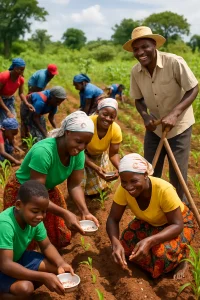
Imagine — a classic scene where families gather, planting their maize seeds in row upon row, each meticulously sown growing stronger through shared knowledge amassed over generations. Minor adjustments, like altering row spacing and number of planting stations, become major catalysts for success.
Cultivating Community Resilience
As the Pfumvudza method blossomed, it forged beyond individual plots to craft a community-centric ethos. Smallholder farmers, once isolated in their challenges, began to band together. With shared practices and mutual support, they cultivated not only crops but also resilience and hope.
The philosophy of Pfumvudza celebrates the unity of the farmer’s spirit — cultivating not just the earth, but also the very fabric of community ties, nurturing relationships that transcend mere transactions to foster a culture of stewardship and generosity.
The Times of Recognition
Over the years, as the success stories of Pfumvudza began to unfurl like blossoms in spring, recognition swelled. Governments and non-profit organizations alike recognized the potential of this method as a grassroots approach to combating food insecurity. It became a shining model of sustainable agriculture, one that demonstrated that simplicity could be a path to greatness.
Conclusion: The Continuation of the Journey
As we conclude our exploration of the history and origins of the Pfumvudza method, let us carry forth this profound truth: agricultural practices evolve, not in isolation, but through the dialogue of communities. Through this legacy of knowledge and innovation, Pfumvudza not only seeks to feed families but to grow resilience, empowering farmers to rise against the tides of adversity.
May we continue to sow the seeds of wisdom, nurturing the dreams of bright futures through sustainable farming practices.
Thank you for being a part of this historical journey with us! Let’s harvest our understanding as we embrace the next topic in our lesson! 🌱✨