

Opportunities in sexuality education, SEL and health literacy

Jukka 5.9.2025
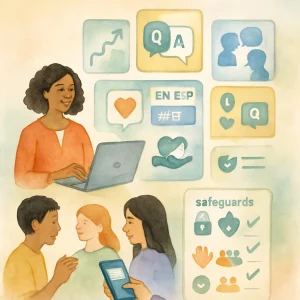
Welcome — this topic shows concrete, practical ways AI can help personalize sexuality education, social‑emotional learning (SEL) and health literacy for diverse learners. We’ll focus on things you can try in classrooms or products, plus guardrails to keep young people safe, equitable and respected.
Quick overview
AI can:
- Personalize content and pacing for different learners.
- Scale trusted, culturally relevant resources (especially where human experts are scarce).
- Provide tailored SEL practice (role‑plays, feedback, emotion coaching).
- Offer discreet, anonymous entry points for sensitive questions.
- Surface early indicators of wellbeing concerns so adults can act proactively.
All of this works best when paired with clear ethics, human oversight and community co‑design.
Learning goals for this topic
By the end of this topic you’ll be able to:
- Name at least five concrete, classroom‑ready AI uses for sexuality education, SEL and health literacy.
- Design a simple, responsible pilot that uses AI to personalize learning or provide anonymous info to students.
- Articulate key safeguards (privacy, consent, content moderation, cultural responsiveness) required when using AI with young people.
- Use a short checklist to evaluate whether an AI tool is appropriate for your learners.
Concrete ways AI can help (with examples)
-
Adaptive, personalized learning paths
- How: AI analyzes learner responses and performance to recommend what to study next (e.g., more foundational content, different media type).
- In practice: A student who struggles with consent vocabulary gets extra micro‑lessons and vocabulary games; another who masters it advances to scenarios about online relationships.
- Why it helps: Meets learners where they are, reduces embarrassment, supports mastery.
-
Anonymous, safe Q&A tools and triage chatbots
- How: A moderated chatbot answers common questions about relationships, puberty, STIs, contraception and mental health; sensitive questions get flagged for a human counselor.
- In practice: Students can ask privately after class and get age‑appropriate answers plus links to local services. The bot uses pre‑approved responses and signposts to professionals.
- Why it helps: Students often avoid asking sensitive questions publicly; anonymity increases access.
-
Scenario‑based role‑plays and simulated conversation practice
- How: AI simulates peers, parents or adults for role‑play practice (e.g., refusing pressure, discussing boundaries).
- In practice: Students practice saying “no” in a safe virtual space and receive feedback on clarity, tone and safety planning.
- Why it helps: Builds practical SEL skills and communication habits through low‑risk rehearsal.
-
Emotion recognition and personalized SEL coaching (with caution)
- How: AI tools can support reflection by analyzing journal entries, voice tone or facial expressions and offering prompts for emotion regulation.
- In practice: A journaling app suggests coping strategies when a student expresses sadness; teachers get aggregated, anonymized trends.
- Why it helps: Timely nudges support emotion awareness, but this is high‑risk and needs strict consent and transparency.
-
Multilingual, culturally responsive content scaling
- How: AI translates materials and adapts examples to cultural contexts or reading levels.
- In practice: An educator uses AI to produce local language versions of sexual health infographics and culturally relevant case studies.
- Why it helps: Increases accessibility and relevance for diverse learners.
-
Microlearning and nudges for health literacy
- How: Personalized text or app notifications remind learners about menstrual health, vaccination schedules, sleep hygiene, or coping strategies.
- In practice: A student gets a brief, age‑appropriate explainer about contraception options timed to a lesson.
- Why it helps: Short, regular nudges support retention and behavior change.
-
Analytics to identify needs and improve programs
- How: Aggregated learning analytics flag concepts where many learners struggle or where wellbeing indicators change.
- In practice: Data shows multiple students confused about consent in online contexts — teacher adjusts curriculum.
- Why it helps: Enables responsive instruction and targeted resources.
Hands‑on mini‑activities you can try
Activity A — Build a safe, classroom Q&A pilot (low tech)
- Pick a small scope (e.g., puberty, consent basics).
- Curate a short set of trusted answers (age‑appropriate, medically verified).
- Create a “submission box” (digital form or anonymous paper) where students send questions.
- A trained educator reviews and answers weekly; anonymized FAQs are shared with class.
- Optional: Use an AI writing assistant to draft responses, then review/approve before publishing.
Activity B — Role‑play with an AI script
- Create 3 short scenarios (peer pressure, online boundary, asking for help).
- Use a controlled AI chat simulator with pre‑loaded persona scripts (or have students practice with a teacher playing the role).
- Students practice responses, then reflect on what worked, what felt hard.
- Debrief: discuss feelings, strategies, and when to escalate for help.
Activity C — Personalization experiment
- Select a class unit and create 2–3 content versions (video, text, interactive quiz).
- Ask students about preferred learning styles and baseline knowledge.
- Use a simple decision rule or basic AI tool to recommend content versions to learners.
- Measure comprehension after completion and collect learner feedback.
Activity D — Co‑design session with young people
- Invite a diverse student panel.
- Workshop: What AI features would feel helpful? What would feel creepy or unsafe?
- Use their feedback to create design principles and safeguards before piloting.
Practical implementation tips
- Start small and scoped. Pilot with one topic, grade level or cohort.
- Keep a human‑in‑the‑loop. Always ensure a trained adult reviews flagged content and handles referrals.
- Use curated knowledge bases. For medical/sexual health info, rely on vetted sources rather than raw web search.
- Document escalation pathways. Make it clear when and how questions are routed to school counselors or health professionals.
- Involve parents and community. Communicate goals, safeguards and opt‑in/opt‑out options early.
- Make interfaces private by default. Use anonymous or pseudonymous modes when appropriate.
Safeguards, ethics and policy essentials
High‑level checklist before you pilot any AI tool with young people:
- Purpose: Is the tool solving a clear educational or wellbeing problem?
- Age‑appropriateness: Content, tone and interactions match developmental stage.
- Consent & opt‑in: Students and caregivers understand and consent to data use.
- Data minimization: Collect only what you need; store it securely and delete when no longer necessary.
- Human oversight: Ensure educators or counselors review sensitive interactions.
- Transparent limitations: Tell users what the AI can and can’t do; make signposting explicit.
- Cultural responsiveness: Materials are reviewed by diverse stakeholders for relevance and respect.
- Safety filters & moderation: Implement content filters and protocols for self‑harm, abuse or sexual exploitation.
- Compliance: Follow local laws (e.g., COPPA, FERPA, GDPR) and school policies.
- Auditability: Keep logs and rationale for decisions; allow independent review.
Red flags that mean “don’t deploy”
- The tool gives medical or legal advice without professional oversight.
- It collects identifiable health or sexual history data unnecessarily.
- There’s no clear escalation plan for harm disclosures.
- Parents or students aren’t informed or can’t opt out.
Accessibility and inclusion considerations
- Offer multiple modes (text, audio, visuals) and reading levels.
- Translate content and validate translations with native speakers.
- Design for neurodiversity: chunk content, allow more time, provide examples and scaffolds.
- Check cultural appropriateness: examples, images and metaphors should be locally meaningful.
- Ensure privacy for marginalized students who may face additional risks.
Evaluation: how to know it’s working
Measure both learning and wellbeing outcomes:
- Learning gains: pre/post quizzes, competency checks, demonstration tasks.
- SEL progress: self‑reports of emotion regulation, perspective‑taking, or measured behavior changes.
- Engagement metrics: completion rates, time on task, voluntary use.
- Equity metrics: who’s using it? Are certain groups excluded?
- Safety metrics: number of escalations, false positives/negatives in moderation, user complaints.
- Qualitative feedback: student, teacher and caregiver interviews.
Combine quantitative data with qualitative stories — numbers don’t tell the whole picture.
Quick sample prompts / guardrails for educators using generative AI (for drafting only)
-
Prompt template for an age‑appropriate explainer:
“Write a short, neutral, age‑12‑appropriate explanation (100–150 words) about how to talk to a trusted adult about a relationship that makes you uncomfortable. Use simple language, avoid graphic details, and include 2 steps the student can take right away and one adult resource to contact.” -
Safety guardrail: Always review and edit AI drafts. Never publish or share AI answers with students without human review, particularly on sensitive health or sexual topics.
Reflection questions for class discussion or staff planning
- How would we handle a student disclosure made to an AI tool?
- Which topics are appropriate for AI support and which require human facilitation?
- What biases might show up in AI recommendations for sexual health or SEL, and how can we detect them?
- Who in our community (students, caregivers, clinicians) should be part of co‑design?
Resources to consult (types)
- Local public health and education guidelines for sexuality education.
- Professional bodies on SEL frameworks (e.g., CASEL‑style principles).
- Legal/privacy guidance for children’s data (local laws + international frameworks).
- Research on AI ethics in education and youth wellbeing.
- Lists of vetted medical/sexual health information providers (for building knowledge bases).
Short checklist you can print/use right now
- Define learning goal and scope.
- Curate verified content sources.
- Obtain consent (students + caregivers as needed).
- Ensure human review & escalation protocols.
- Test with a small group; collect feedback.
- Monitor outcomes and harms; iterate or stop if harms appear.
Wrap‑up
AI can meaningfully expand access, personalization and practice opportunities in sexuality education, SEL and health literacy — but only if you pair the tech with clear ethical guardrails, human oversight and student voice. Start small, design with young people, and be prepared to pause and adapt when risks surface.
Want a one‑page printable checklist, sample consent language, or a starter rubric to evaluate AI tools for your classroom? I can draft those next.
