

Regulatory and classification issues (especially for minors)

Jukka 5.9.2025
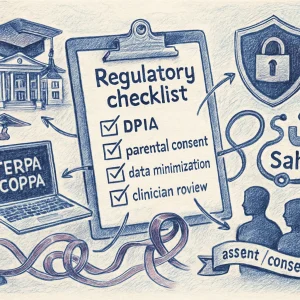
When an educational tool starts to touch health, mental health, sexual health, or clinical territory — even indirectly — the regulatory landscape changes. Laws about medical devices, data protection, parental consent, mandatory reporting, and adolescent consent can apply. This topic walks you through the practical regulatory considerations, the common age-related rules you’ll run into, and concrete steps educators, designers and policy makers should take before using or procuring such tools for young people.
Note: this is a practical overview, not legal advice. Always consult legal and clinical experts for specific decisions.
Why this matters
- Regulators don’t care whether your app is called “education” or “wellness” if it gives health-related recommendations, diagnoses, or treatment suggestions — that can trigger medical device or health-service rules.
- Minors are a protected group in many laws. Their data and their ability to consent are treated differently than adults’.
- Schools and vendors may unintentionally create legal exposure (and harm to students) by collecting sensitive health information or failing to follow reporting/consent rules.
Key regulatory categories you’ll encounter
-
Medical devices / Software as a Medical Device (SaMD)
- If a tool is intended to diagnose, prevent, monitor, treat or alleviate disease or injury, it may be regulated as a medical device (FDA in the U.S., EU MDR/IVDR in Europe, MHRA in UK, etc.).
- Claiming clinical efficacy or providing individualized diagnostic/therapeutic recommendations is a big trigger.
- For software, regulators look at intended use and risk. High-risk functions (clinical decision support, diagnosis) typically require more evidence and approvals.
-
Data protection and privacy laws
- GDPR (EU): Strong protections for children’s data. Special category data (health, sexual life, orientation) has extra safeguards. Consent age under Article 8 varies by member state (generally 13–16).
- COPPA (U.S.): Applies to online services directed to children under 13 — requires parental consent for data collection, clear privacy policies, and deletion rights.
- FERPA (U.S.): Student educational records in schools. If a product handles education records, it may be subject to FERPA controls.
- HIPAA (U.S.): Applies when a “covered entity” or business associate processes protected health information. Many ed‑techs are not HIPAA-covered unless they integrate with healthcare providers.
- Local/state laws: many U.S. states have adolescent health confidentiality laws (re: sexual and reproductive health, mental health, substance use).
-
Child protection / mandatory reporting
- In many jurisdictions, educators are mandatory reporters of suspected child abuse or self-harm. Tools that surface disclosures (e.g., chatbots) can create duties to act.
- Systems must include safe escalation paths and clear policy about who reviews flagged content.
-
Emerging AI regulation
- AI-specific laws (e.g., proposed EU AI Act) are mapping higher risk categories for systems used in health, and some cover systems interacting with minors more strictly.
- Expect evolving requirements for transparency, human oversight and risk management.
Consent, assent, and age-related rules — practical points
-
Age-based consent thresholds:
- Under COPPA, under-13s require verifiable parental consent for data collection.
- Under GDPR, many countries set age of consent for information society services at between 13–16; below that parental consent is needed for processing personal data.
- For clinical services (e.g., contraception, mental health) many jurisdictions allow minors to consent to specific services without parental permission — check local laws.
-
Consent vs assent:
- Even when parents legally must consent, minors should be given age-appropriate explanations (assent) and the option to decline non-essential features.
- Assent is ethically important even if not legally required.
-
Sensitive data = higher protection:
- Health, sexual orientation, sex life, mental health, self-harm ideation are typically treated as sensitive. Require explicit legal bases and stronger safeguards.
-
Confidentiality tensions:
- Minors may have statutory rights to confidential sexual or mental healthcare. Schools must balance parental rights with these protections.
- Tools that capture disclosures should not automatically notify parents — policies must align with local confidentiality laws and reporting duties.
Classification decision flow (simple practical heuristic)
-
Does the tool make clinical/diagnostic/therapeutic claims or give individualized treatment recommendations?
- If yes → treat it as SaMD / health service: engage clinical experts, expect medical regulation.
-
Does the tool collect health or sexual behavior data, mental health indicators, or self-harm ideation?
- If yes → apply strict data protection measures, consider mandatory reporting obligations.
-
Is the user a minor (under local consent ages) or does the service target children?
- If yes → apply child-focused consent and privacy rules (COPPA/GDPR limits), minimize data collection, use parental consent where required.
-
Is the tool used in a formal school setting or interfacing with school records?
- If yes → involve school legal/procurement teams (FERPA, vendor contracts).
If you answered “yes” to any of the above, escalate to legal/clinical review and require stronger safeguards.
Practical checklist before deploying or adopting a tool
-
Classification & claims
- [ ] Review marketing and in-product language for clinical claims. Remove or rephrase claims that imply diagnosis/treatment unless you intend medical regulation.
- [ ] Have a clinician review health-related content for accuracy and risk.
-
Data protection & consent
- [ ] Map data flows: what is collected, stored, shared, for how long, where.
- [ ] Determine lawful basis for processing minors’ data; obtain parental consent where required.
- [ ] Limit collection to minimum necessary; avoid collecting sensitive health details unless essential.
- [ ] Conduct a Data Protection Impact Assessment (DPIA) for tools that process health data or target children.
- [ ] Ensure age verification appropriate for your context.
-
Safety & reporting
- [ ] Define protocols for disclosures of harm, abuse, or self-harm flagged by the tool.
- [ ] Train staff who will monitor or receive reports from the tool; specify escalation roles.
- [ ] Log all decisions and communications around disclosures for accountability.
-
Vendor & procurement due diligence
- [ ] Ask vendors for documentation: privacy policy, data retention, security measures, certifications (ISO 27001, SOC 2), evidence supporting health claims.
- [ ] Require contractual guarantees about data use, deletion, BAA (if HIPAA applies), and liability.
- [ ] Ensure on‑premises or regional hosting options to meet local data residency rules if needed.
-
Accessibility & inclusion
- [ ] Check that the tool respects diverse sexual orientations, genders, and cultural contexts.
- [ ] Avoid paternalistic default settings that expose sensitive info to parents/schools.
Questions to ask vendors (quick script)
- What is the intended use of the tool? Are there any clinical claims?
- Does the tool collect health, sexual, or mental health data? How is that defined?
- Where is data stored, for how long, and who has access?
- Do you process data from children under 13/16? How do you obtain and verify parental consent?
- Do you have a DPIA, security audits, or relevant certifications (ISO 27001, SOC 2)?
- How do you handle disclosures of abuse, self-harm, or sexual activity?
- Will you sign contractual terms that limit use of data to agreed educational purposes and prohibit sharing with third-party advertisers?
Red flags — things that should stop you and trigger review
- The tool promises diagnosis, treatment, or individualized clinical recommendations for students.
- The tool collects explicit sexual behavior, abortion, STI, or self-harm content without clear clinical oversight.
- Vendor refuses to sign a contract restricting data reuse or to provide security/privacy documentation.
- No clear plan for handling disclosures, plus automated responses that could escalate risk (e.g., telling a minor to take action without human review).
- Age verification is absent or weak for systems that interact with minors.
Classroom and procurement best practices (short list)
- Prefer tools that provide generic, educational health information rather than personalized diagnosis.
- If personalized support is needed (e.g., mental health screening), involve licensed clinicians and use HIPAA/health-compliant vendors.
- Always minimize data collection and retention; default to “no” for unnecessary sensors or free-text health responses.
- Build clear consent/assent flows: parent consent where required; child-friendly explanations and the ability to opt out.
- Document everything: risk assessments, DPIAs, clinician approvals, contracts, training, and incident responses.
Quick resources to look up (by name)
- FDA guidance on Software as a Medical Device (SaMD)
- EU Medical Device Regulation (MDR) and proposed AI Act
- GDPR Article 8 (children’s consent) and rules on special categories of data (health)
- COPPA (U.S.) — children under 13
- FERPA (U.S.) — student records
- Local mandatory reporting laws and adolescent health confidentiality statutes
Final thought: when education and health overlap, you’re not just dealing with policy boxes — you’re handling young people’s bodies, identities and safety. Err on the side of fewer data grabs, clearer human oversight, and legal/clinical review. If a tool might be giving health advice or asking about intimate things, treat it like a health intervention until proven otherwise.
