


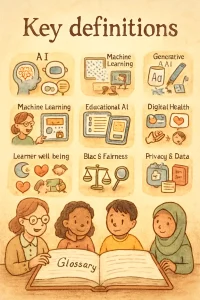
Before we get into the nitty-gritty of designing, choosing and governing AI tools for young people, let’s make sure we’re all speaking the same language. Below are plain-language meanings and quick examples you can actually use in a classroom, product meeting, or policy conversation.
If something here feels fuzzy, that’s okay — these definitions are practical, not academic. We’ll revisit them through activities and real tools later in the course.
Artificial intelligence (AI)
Plain language: software that performs tasks people normally think of as needing “thinking” — like recognizing patterns, making predictions, generating language or images, or recommending what to do next.
Examples: a spam filter, a program that grades essays, a chatbot that answers student questions.
Why it matters here: AI can automate or augment decisions that affect learners’ health, privacy and emotional safety. Knowing what AI does helps you ask the right questions about risks and benefits.
Machine learning (ML)
Plain language: a way of building AI by letting the system learn patterns from lots of data instead of being told every rule manually.
Example: an app that learns which practice problems a student struggles with by analyzing past responses and then recommends targeted review.
Why it matters: ML systems can change over time, and their behavior depends heavily on the data they were trained on — which affects fairness, accuracy and safety.
Model, algorithm, and training vs inference
Plain language:
- Algorithm: a set of instructions or rules the computer follows.
- Model: the result of training an algorithm on data — it’s what makes predictions or produces output.
- Training: the phase when the model learns from data.
- Inference: when the model is used to make a prediction or provide an output for a user.
Example: You train a model on thousands of math problem attempts (training). Later, the model recommends hints to a student (inference).
Why it matters: The decisions made during training (what data, whose data, how labeled) shape real-world behavior during inference — and therefore learners’ experiences.
Generative AI
Plain language: AI that creates new content — text, images, audio, video — based on patterns it learned.
Examples: a chatbot that writes story prompts, an image generator used for illustrations, or an audio tool that simulates a teacher’s voice.
Why it matters: Generative outputs can be helpful but may also be inaccurate, biased, or create privacy/safety issues (e.g., fabricating sensitive content).
Educational AI (EdAI)
Plain language: AI-based tools designed primarily to support teaching, learning or educational administration.
Examples:
- Adaptive learning platforms that personalize practice problems.
- Intelligent tutoring systems that provide feedback.
- Automated grading tools.
- Chatbots that answer curriculum questions.
Why it matters: EdAI sits at the intersection of pedagogy and tech — it should help learners thrive, not just optimize metrics like completion or clicks. That means attention to learning outcomes, fairness, accessibility and privacy.
Digital health
Plain language: digital tools and services intended to support health, wellness or medical care. This includes apps, wearables, telehealth systems and health-focused AI.
Examples: symptom checkers, mental health chatbots, step counters, apps that manage contraception reminders, teletherapy platforms.
Why it matters for learners: Digital health tools can support physical, mental and sexual health — but they often collect health data, and they may be subject to different legal and safety rules than education tech.
Where Educational AI and Digital Health overlap
Short plain language: Some tools are both EdAI and digital health. For example, an app in schools that monitors students’ mood (for social-emotional learning) and flags risk of self-harm is doing both education and health work.
Why it matters: Overlap introduces extra ethical, legal and safety considerations — think confidentiality, parental consent, mandatory reporting, and clinical validity.
Learner well‑being
Plain language: the overall health and thriving of a learner — including physical health, mental and emotional well-being, social connection and safety, sexual health and the capacity to learn and flourish.
Components we’ll focus on in this course:
- Mental and emotional health (stress, depression, anxiety, SEL)
- Physical health (sleep, activity, medical conditions)
- Sexual health and safety (education, consent, resources)
- Social and relational health (bullying, connection, belonging)
- Ability to engage in learning (concentration, motivation)
Why it matters: Tools and policies should support these dimensions, not undermine them. A “useful” feature that harms sleep or privacy is not acceptable when learner well‑being is the goal.
Bias, fairness and harm (quick notes)
Plain language:
- Bias: when a system systematically disadvantages some people because of the data, design choices or assumptions behind it.
- Fairness: the goal of avoiding unjust or harmful differences in how people are treated.
- Harm: any negative outcome — physical, emotional, social or educational — that a tool causes or contributes to.
Why it matters: Even well-intended AI can produce biased or harmful outcomes, especially for young people whose needs and rights differ from adults.
Privacy, consent and data types
Plain language:
- Personal data: anything that identifies or could identify a person (name, email, ID).
- Sensitive data: health, sexual orientation, disability, biometric data — extra care required.
- Consent: agreement to collect/use data; with minors, consent rules differ by jurisdiction and context.
Why it matters: Many education tools collect sensitive information. You need to know what’s collected, why, for how long, and who can see it.
Regulation and legal terms (super-short)
Plain language:
- FERPA (US): rules about students’ education records and school responsibilities.
- HIPAA (US): rules protecting certain health information in clinical settings.
- GDPR (EU): broad data protection law with special protections for children.
Why it matters: Different laws may apply depending on whether a tool is educational, clinical, or both. That affects what data you can collect and store, and what protections you must provide.
Quick practical checklist: Is this tool primarily educational AI, digital health, or both?
Ask:
- What is the tool’s main purpose? (teaching/learning vs healthcare/wellness)
- What outcomes does it aim to affect? (academic skill vs clinical symptom)
- What data does it collect? (test answers vs health metrics)
- Who uses it and how? (teachers/admin vs clinicians/parents)
- Is there clinical intent or claim? (does it diagnose or treat?)
If you answer “both” to several questions, treat the tool as both EdAI and digital health.
How we’ll use these words in the course
- We’ll use “AI” as an umbrella term and be specific (ML, generative AI) when needed.
- “Educational AI” will signal tools intended for learning/teaching; “digital health” for health or wellness.
- “Learner well‑being” is our north star — we’ll evaluate tools, designs and policies by whether they support thriving.
- When legal or clinical terms come up, we’ll explain their practical implications for educators and designers.
Short glossary (one-liners)
- AI: software that can perform tasks that look like “thinking.”
- ML: systems that learn patterns from data.
- Generative AI: AI that makes new content (text, images, audio).
- Educational AI: AI tools made for teaching/learning.
- Digital health: digital tools for health or medical support.
- Learner well‑being: students’ physical, mental, social and sexual health and safety.
- Bias: unfair systematic differences in outcomes.
- Sensitive data: data needing extra protection (health, sexual, biometric).
- Inference: when a model is used to make a prediction or give output.
Reflection prompt (quick)
- Think of one tool you currently use or consider using with learners. Label it: educational AI, digital health, or both. What data does it collect? Does that collection feel appropriate for learners’ well‑being? Bring this example to the next activity.
If you want, I can create a printable one-page cheat sheet of these definitions tailored to your school or organization. Want that?
