


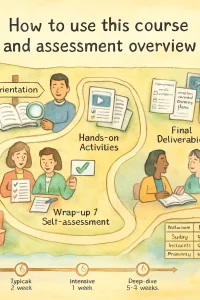
Welcome! This topic explains how the course is organized, how much time you should expect to spend, what activities you’ll do, what you’ll produce, and how you’ll be assessed — plus ways to self‑evaluate if you’re taking the course independently.
Think of this as your road map: quick, practical, and flexible so you can fit the course into your schedule and get useful artifacts you can take back to your classroom, product design process, or policy work.
Quick course flow (what happens, in plain language)
- Orientation: meet the course goals and key definitions (this lesson).
- Core modules: each module links a Responsible AI principle to practice (readings, short video, case studies).
- Hands‑on activities: lightweight, tool‑focused exercises and a classroom/product risk assessment.
- Reflection & peer exchange: short discussion prompts and optional peer review.
- Final deliverable: a concise practical artifact (e.g., classroom adaptation plan, product risk checklist + mitigation plan, or short policy brief).
- Wrap‑up: final self‑assessment and next steps/resources.
You’ll move from understanding the principles → applying them to real situations → producing a small, usable deliverable.
Time expectations (recommendations)
This is a short, practical course. Below are suggested paces; pick what works:
-
Typical paced version (recommended): ~2 weeks, 4–6 hours total
- Orientation + Foundations: 30–45 min
- Each module (3–4 modules): 45–60 min each (reading/video + activity)
- Hands‑on assessments & final deliverable: 90–120 min total
- Reflection & peer activities: 30–60 min
-
Intensive one‑week version: plan for 6–8 hours across 2–3 focused sessions.
-
Self‑study / deep dive: spread over 3–4 weeks, add optional readings and extra practice.
Time breakdown for a single module:
- Watch short video: 8–12 min
- Read core text/case: 10–25 min
- Do the activity or checklist: 20–40 min
- Post/reflection in discussion (optional): 10–20 min
Types of learning activities
- Short, focused videos (10–15 min) to introduce ideas.
- Readings (practical, not just theory).
- Case studies featuring classroom, SEL, sexuality education and product examples.
- Hands‑on worksheets and checklists (risk assessment, consent templates, accessibility review).
- Small design exercises (adapt prompts, tweak prompts for inclusive language, map user flows).
- Reflection prompts and journaling.
- Optional peer review or group session activities.
All activities are designed so you can apply them to real work immediately.
Deliverables — what you’ll produce
You won’t write a thesis. Deliverables are practical and short. Examples (choose one as your final artifact unless instructed otherwise):
-
Option A — Classroom/Product Risk Assessment (required fields completed): ~1–2 pages
- Identify potential harms, affected learners, likelihood, severity, proposed mitigations, monitoring plan.
-
Option B — Learner‑Centered Adaptation Plan: ~1 page
- How you would adapt an AI tool, curriculum, or assessment to protect wellbeing, inclusion, and sexual health learning goals.
-
Option C — Short Policy Brief: ~1–2 pages
- Executive summary, problem statement, recommended policy action, brief implementation notes.
Supporting items:
- Short quiz completion (multiple choice / knowledge check) — usually automated.
- Reflection journal entry (300–500 words) or 5–7 bullet points.
- Optional: Peer feedback you gave / received (1–2 paragraphs).
You’ll upload deliverables to the LMS assignment area or paste into the assignment box. Templates and worksheets are included in the Resources section.
Assessment overview — how you’ll be evaluated
We design evaluation to be practical, transparent and fair. Assessment mixes automated checks, instructor (or facilitator) feedback, and self/peer evaluation.
Types of assessment:
- Automated knowledge checks (quizzes): check basic comprehension of definitions and core principles. Instant pass/fail or percent score.
- Formative feedback: short, constructive comments on your activities (instructor or peer).
- Summative assessment: review of your chosen final artifact against a short rubric.
- Self‑evaluation: guided checklist and reflection prompts that help you judge your own progress.
Passing / completion criteria (example):
- Complete all module activities and quizzes (or a predefined %).
- Submit one final deliverable (Options A–C): meets minimal rubric thresholds.
- Complete reflection worksheet and optional peer review (if required).
Certificate or badge issuance (if your program offers one) will be based on completion of the above.
Example assessment rubric (practical, one‑page)
Each final artifact is scored on 4 criteria (0–3 points each). Total 12 points.
-
Relevance to learners / stakeholders (0–3)
0 = irrelevant / missing; 1 = weakly connected; 2 = mostly relevant; 3 = clearly centered on learners/stakeholders. -
Safety & risk mitigation (0–3)
0 = no risks identified; 1 = superficial; 2 = reasonable mitigations; 3 = clear, practical, prioritized mitigations and monitoring plan. -
Inclusion & equity (0–3)
0 = not addressed; 1 = partial; 2 = addresses multiple groups; 3 = thoughtful, specific accommodations and inclusive language. -
Practicality & clarity (0–3)
0 = unusable / unclear; 1 = scattered ideas; 2 = actionable but needs work; 3 = concise, implementable steps and next actions.
Scoring guide:
- 10–12 points = Excellent (meets all goals)
- 7–9 points = Good (minor revisions suggested)
- 4–6 points = Needs work (resubmit recommended)
- 0–3 points = Major revision required
You’ll get brief written feedback tied to these criteria.
Self‑evaluation checklist (use after each module)
Quick yes/no / small note prompts you can use to reflect:
- Do I understand the principle(s) discussed in this module?
- Can I explain one concrete risk and one mitigation related to my context?
- Did I adapt a tool/curriculum example in a way that protects learner wellbeing?
- Have I considered how this affects equity and inclusion?
- Do I have at least one next action I can take this week?
If you answer “no” to any, jot a quick plan (10 minutes) for what to revisit: a video, the checklist, or a peer.
Reflection prompts (short — use for journal entries)
Choose one or two to answer in 300–500 words or 5–7 bullets:
- What is the single biggest risk an AI tool in your context could pose to learner health or sexuality education? What would you do first to reduce it?
- Whose voices are missing from the design/decision process in your setting, and how would you include them?
- Describe one change to a lesson, tool, or policy that would make it safer and more inclusive for learners.
Tips for success (practical, from educators)
- Start with your context: keep activities tied to a specific classroom, product, or policy scenario. Concrete beats abstract.
- Use the templates — they save time and align with assessment criteria.
- Don’t aim for perfection on the first pass: iterate. The rubric rewards clarity and practicality, not verbosity.
- Use peer feedback—others spot blind spots you won’t.
- Keep privacy in mind: when discussing learner examples, anonymize identifying info.
For facilitators or instructors (if you’re running this cohort)
- Suggested facilitation cadence: 1 synchronous check‑in (30–45 min) mid‑course to discuss cases and one final showcase session (30–60 min).
- Provide 48–72 hour turnaround for instructor feedback where possible.
- Encourage peer review using the rubric to scale feedback.
- Adapt artifacts: for teacher cohorts you might require Option A (classroom risk assessment); for product teams, require Option B.
Accessibility, privacy and accommodations
- All videos have captions and transcripts. Readings are accessible formats.
- If you need extended time or alternate formats, request accommodations through the LMS support channel.
- When submitting examples that involve real learners, remove names and any identifiable data. Use fictionalized or consented anonymized cases.
Where to find resources in the course
- Resources folder: templates (risk checklist, consent language, policy brief template), glossary, further reading.
- Assignment area: upload deliverables and see status.
- Discussion boards: for peer exchange and optional peer review.
If you want, tell me your role (teacher, product designer, policymaker) and how many hours you have to commit. I’ll suggest a personalized pace and which final deliverable fits you best.
