


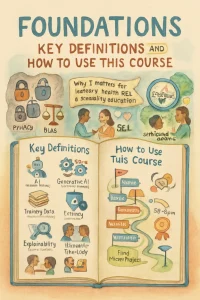
Welcome! This lesson sets the stage for the course by making sure we share a common language, a clear map of what’s ahead, and a quick orientation to why responsible AI matters for learners’ health, sexuality education, social‑emotional learning (SEL) and overall well‑being.
Below you’ll find three short topics. Each one is practical and designed to get you usable knowledge fast — not theory for theory’s sake. You’ll leave this lesson able to explain core terms, navigate the course and assessments with confidence, and make the case for why this work is essential for educators, designers and policy makers.
Estimated time: 30–45 minutes
What you’ll do in this lesson
- Read concise definitions and examples of key AI terms.
- Learn how this course is organized and what assessments look like.
- Reflect on why responsible AI matters for young people and your work.
Topics in this lesson
-
Key definitions
A compact glossary of the terms we’ll use across the course (AI, machine learning, model, generative AI, training data, bias, fairness, explainability, privacy, human‑in‑the‑loop, etc.). Each definition is paired with a short classroom- or product-related example so you can see how the term matters in real situations. -
How to use this course and assessment overview
A quick tour of course structure (lessons, topics, activities), recommended pacing, and the assessments you’ll complete. Expect low-stakes formative checks (quizzes, reflection prompts), interactive activities (scenario analyses, tool assessments), and a final micro‑project or implementation plan. Includes grading/feedback approach, rubric highlights, and tips for getting the most from discussion boards and optional resources. -
Why this matters for educators and young people
A practical, learner-centered explanation of the benefits and risks of AI in contexts that affect young people’s health and well‑being. Short cases illustrate potential harms (privacy breaches, biased content, inappropriate personalization) and benefits (scaffolded support, scalable SEL tools). We’ll also touch on equity, developmental sensitivity, trust-building, and the professional responsibilities that follow.
Quick practical notes
- No prior AI expertise required — this lesson assumes you’re starting from scratch and builds up from there.
- Pace yourself: complete one topic, do the short reflection, then move on.
- Assessment snapshot: complete the topic quizzes and reflections to earn the participation badge; submit a short final micro‑project (3–5 pages or equivalent artifact) to demonstrate applied learning. Detailed rubrics are in the Course Resources module.
- Use the discussion board to share examples from your classroom or product area. Peers’ experiences are one of the best ways to see how these concepts play out.
Why start here?
Getting the language right and understanding the course structure will save you time and help you make stronger, faster choices when you move into the practical activities. It also ensures we all center learner well‑being in every technical or policy decision we make.
Ready? Start with Topic 1: Key definitions — it’s bite‑sized and will make the rest of the course feel much easier to navigate.
