

Building and Contributing to Scholarly Bibliographies

Jukka 2.9.2025
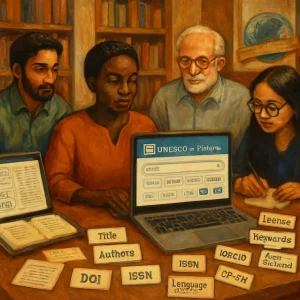
This topic explains how to use and contribute to the UNESCO e‑Platform’s searchable scholarly bibliography for intercultural dialogue. It addresses practical steps for discovery and submission, recommended metadata standards, citation practices, open access considerations, and quality/ethical guidance for contributors.
1. Using the UNESCO e‑Platform Scholarly Bibliography
The e‑Platform functions as a global repository and discovery tool. The interface (see “SCHOLARLY ARTICLES RELATED TO INTERCULTURAL DIALOGUE”) supports searching, filtering, and exporting (Print, Excel, CSV, Copy).
Practical steps for effective use:
- Search and filter: use the search box and filters (year, author/editor, journal, keywords) to narrow results.
- Exporting: export selected records to CSV/Excel for local analysis, reference management, or institutional reporting.
- Cross‑linking: follow DOI, ISBN, ISSN, or repository links provided in records to access full texts or publisher pages.
- Multilingual records: leverage English and French metadata/titles when available; use translated abstracts to assess relevance.
Tip: When assembling a local bibliography for teaching or research, export the CSV and import it into a reference manager (Zotero, Mendeley, EndNote) for consistent citation generation and annotation.
2. Preparing to Contribute: Preliminary Checklist
Before submitting an entry, prepare the following:
- Full bibliographic details (authors, title, year, journal/publisher, volume/issue, pages).
- Persistent identifier(s): DOI, ISBN, ISSN where applicable.
- Abstract in the language(s) of the publication; English and French where possible for this e‑Platform.
- Subject keywords / controlled vocabulary terms.
- Full‑text file OR link to an open repository/publisher page.
- License and access status (e.g., Creative Commons CC BY 4.0; closed access; embargo).
- Contributor roles (author, editor, translator) and institutional affiliations.
- Language of publication and translation metadata if relevant.
- Rights and provenance notes (peer‑reviewed, working paper, conference paper).
3. Submission Workflow (typical)
While specific UI details may vary, the usual workflow on scholarly platforms follows these steps:
- Register / authenticate (create an account; confirm via email).
- Select “Add new record” or equivalent.
- Complete required metadata fields (see recommended schema below).
- Attach full‑text file(s) or provide a stable URL (prefer a DOI link or repository handle).
- Specify access rights and license; attach evidence if necessary (e.g., publisher permission).
- Review and submit for moderation or editorial approval.
- Respond to any queries from platform administrators; track the record status.
- After publication in the platform, check the display and ensure links are functional.
If in doubt, consult the platform’s contributor guidelines or contact the UNESCO Chair / platform administrators for assistance.
4. Metadata Standards and Recommended Fields
Adopting robust metadata standards improves discoverability, interoperability, and long‑term preservation. The e‑Platform can accept records mapped to common standards such as Dublin Core and Crossref metadata. Below are recommended fields and mappings.
Recommended core fields
- Title (dc:title)
- Alternative title / Original language title (dc:alternative)
- Authors / Editors (dc:creator) — include full names and ORCID iDs where available
- Year / Date (dc:date)
- Abstract (dc:description) — provide in original language and an English (and preferably French) translation
- Language (dc:language)
- Journal / Publisher (dc:publisher)
- Volume / Issue / Pages (dc:relation or publisher-specific fields)
- DOI / ISBN / ISSN / Handle (dc:identifier)
- URL to full text (dc:identifier or dc:source)
- Keywords / Subject headings (dc:subject) — use controlled vocabularies where possible (e.g., UNESCO thesauri, Library of Congress Subject Headings)
- License / Rights (dc:rights) — specify Creative Commons or other license; indicate embargo if present
- Contributor roles (e.g., CRediT taxonomy) — clarify roles such as conceptualization, writing, supervision
- Peer‑review status / Publication type (journal article, book chapter, report, policy brief)
- Funding information / Grant numbers
- Notes / Acknowledgements (including Traditional Custodians acknowledgements where appropriate)
- Provenance / Source of submission (who submitted the record)
Recommended technical identifiers and authorities
- ORCID for each author
- DOI for persistent linking (Crossref/Datacite)
- ROR ID for institutions (Research Organization Registry)
- Controlled vocabulary identifiers (e.g., UNESCO subject terms)
Example mapping to Dublin Core (concise):
- dc:title = Title
- dc:creator = Authors/Editors
- dc:date = Publication year/date
- dc:description = Abstract
- dc:identifier = DOI / URL / ISBN / ISSN
- dc:language = Language of the work
- dc:subject = Keywords / subject headings
- dc:rights = License information
5. Citation Practices and Interoperability
Consistent citation practices ensure users can reference works reliably and integrate records with bibliographic tools.
Best practices:
- Always capture and display a standard citation string (e.g., APA and Chicago short form). Provide export options for common styles (APA, Chicago, MLA, Harvard).
- Include machine‑readable metadata (BibTeX, RIS, CSL JSON) to facilitate import into reference managers.
- Use persistent identifiers (DOI, ORCID) in citation strings where possible.
- For bilingual or translated works, include both original and translated citation forms if applicable.
- For chapters, reports, or grey literature, indicate editors and institutional affiliations clearly.
Sample citations for the record:
- APA (example): Kesson, K., & de Oliveira, M. A. (2023). Diversifying Universalism: Neohumanism, Internationalism, and Interculturalism in Education. Praxis Educativa.
- Chicago (author-date): Kesson, K., and M. A. de Oliveira. 2023. “Diversifying Universalism: Neohumanism, Internationalism, and Interculturalism in Education.” Praxis Educativa.
Provide a BibTeX or RIS export for every record to support automated citation generation.
6. Open Access Considerations
Open access (OA) enhances the reach and utility of the bibliography. Contributors should follow OA best practices and be clear about rights.
Key concepts and recommendations:
- Determine the OA route:
- Gold OA: published in an open access journal (include license and publisher).
- Green OA: deposit accepted manuscript in an institutional or subject repository; provide repository link and identify version.
- Hybrid and embargoed content: indicate embargo period and provide metadata even if full text is not public.
- Licensing: recommend CC BY 4.0 for maximal reuse; at minimum, specify an explicit license. Avoid ambiguous “all rights reserved” tags without explanation.
- Depository options: institutional repository, UNESCO repository, or general repositories (Zenodo, Figshare). Provide stable handles/DOIs for deposited files.
- Ensure accessibility: provide machine‑readable full text (PDF/A), and consider alternative formats (HTML, plain text) and language translations.
- Copyright clearance: if depositing publisher versions, ensure compliance with publisher policies (check SHERPA/RoMEO).
- Annotate OA status in metadata: fields such as dc:rights and a dedicated “access” indicator (open/closed/embargoed).
Practical note: Even when full text cannot be uploaded, a complete metadata record with abstract and stable link improves visibility and can lead users to legal access routes.
7. Quality Assurance, Ethics, and Inclusion
Maintaining high metadata quality and ethical standards is critical to the credibility of the bibliography.
Quality checks:
- Verify bibliographic details against publisher databases (Crossref, PubMed, Scopus).
- Confirm DOI and URL validity.
- Check author name disambiguation (use ORCID).
- Confirm peer‑review status and publication type.
Ethical and inclusion considerations:
- Avoid promoting or indexing predatory journals — verify journal legitimacy.
- Respect copyright and license conditions.
- Ensure cultural sensitivity: when including works on Indigenous cultures or other marginalized communities, include appropriate acknowledgements (e.g., Traditional Custodians) and, where appropriate, note permissions / community consent for sharing materials.
- Promote multilingualism: include metadata and abstracts in English and French where possible to reflect the bilingual nature of the e‑Platform and to increase accessibility.
- Acknowledge contributors and funding sources transparently.
8. Example Metadata Record (Illustrative)
The following is a sample metadata record based on the e‑Platform snippet. This demonstrates an entry that a contributor might prepare.
Metadata (human‑readable)
- Title: Diversifying Universalism: Neohumanism, Internationalism, and Interculturalism in Education
- Authors: Kesson, K.; de Oliveira, M. A.
- Year: 2023
- Journal: Praxis Educativa
- Abstract: [Author abstract in original language; English translation if original is not English]
- DOI: [if available]
- ISSN: [journal ISSN]
- Language: English
- Keywords: interculturalism; education; neohumanism; internationalism; diversity
- License: CC BY 4.0 (if open access)
- Full text: [URL to publisher page or institutional repository; attach PDF if permitted]
- Contributor ORCID(s): 0000‑0001‑xxxx‑xxxx (example)
- Peer‑review status: Peer‑reviewed journal article
Machine‑readable snippet (example in JSON‑like form)
{
"title": "Diversifying Universalism: Neohumanism, Internationalism, and Interculturalism in Education",
"creators": [
{"name":"Kesson, K.","orcid": "0000-0002-xxxx-xxxx"},
{"name":"de Oliveira, M. A.","orcid": "0000-0003-xxxx-xxxx"}
],
"date": "2023",
"publisher": "Praxis Educativa",
"type": "Journal Article",
"language": "en",
"identifiers": {"doi": "10.xxxx/xxxxx", "issn": "xxxx-xxxx"},
"rights": "CC BY 4.0",
"description": "Abstract text here…",
"subjects": ["interculturalism","education","neohumanism"]
}
Provide BibTeX/RIS on export for downstream use.
9. Editorial and Administrative Responsibilities
If you are an editor or platform administrator, implement the following processes:
- Metadata validation on submission (automated checks for DOI, ORCID, URL).
- Human moderation for content appropriateness and quality.
- Versioning policy: indicate updated records and preserve original versions with provenance notes.
- Regular export and backup of the bibliography (CSV/Excel) for preservation and reporting.
- Transparent contributor guidelines and a helpdesk for submissions.
10. Practical Checklist for Contributors (Summary)
- [ ] Create or confirm account and ORCID.
- [ ] Gather complete bibliographic metadata and persistent identifiers.
- [ ] Prepare an abstract and, if possible, an English and French translation.
- [ ] Choose and note license and access status.
- [ ] Upload full text or provide stable repository/publisher link.
- [ ] Use controlled subject terms and include keywords.
- [ ] Declare contributor roles and funding sources.
- [ ] Submit and check for administrative feedback.
- [ ] After publication, verify record accuracy and functional links.
11. Further Resources
- UNESCO e‑Platform on Intercultural Dialogue (start page and resources)
- Dublin Core Metadata Initiative (DCMI)
- Crossref / DataCite (DOI registration and metadata best practices)
- ORCID (researcher identifiers)
- Creative Commons licenses (choose and interpret licenses)
- SHERPA/RoMEO (publisher open access policies)
- CRediT taxonomy (contributor roles)
Contributing accurate, well‑structured metadata and open access materials to the UNESCO e‑Platform strengthens global scholarship on intercultural dialogue, enhances equitable knowledge exchange, and honours the Platform’s commitments to inclusion, multilingualism, and the acknowledgement of Traditional Custodians.
