

Resources and Digital Platforms: UNESCO e‑Platform

Jukka 2.9.2025
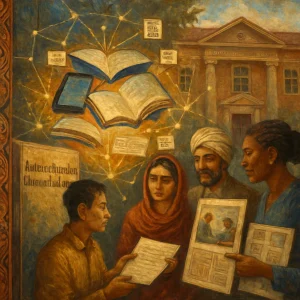
This lesson examines the UNESCO e‑Platform on Intercultural Dialogue as a primary digital resource for research, teaching and practice in intercultural dialogue. Grounded in UNESCO’s definition of intercultural dialogue—an equitable exchange based on mutual understanding, respect and the equal dignity of all cultures—the e‑Platform functions as a global hub for curated publications, a comprehensive searchable scholarly bibliography and practice-oriented case studies. Materials on the site reflect the collaborative work of the UNITWIN/IDIU Network and are maintained by the UNESCO Chair for Cultural Diversity and Social Justice at Deakin University. These resources complement the bilingual volume Interculturalism at the Crossroads (L’interculturalisme à la croisée des chemins) and embody commitments to inclusion and formal acknowledgement of Traditional Custodians.
Through this lesson, participants will learn how to locate, interpret and apply the e‑Platform’s resources to support evidence‑based practice and scholarly inquiry in intercultural dialogue. Emphasis is placed on practical navigation, critical engagement with case studies and methods for building and contributing to scholarly bibliographies.
Learning objectives
By the end of this lesson, learners will be able to:
- Confidently navigate the UNESCO e‑Platform and locate relevant publications, databases and case studies.
- Critically analyse case studies and best practices to inform intercultural programme design and evaluation.
- Construct, manage and contribute to scholarly bibliographies using the e‑Platform’s searchable records and export functions.
- Recognise the institutional networks and ethical commitments (inclusion, diversity and acknowledgement of Traditional Custodians) that shape the curation of the e‑Platform.
Lesson topics
-
Navigating the UNESCO e‑Platform
Introduces the platform’s structure, search functions and export options; demonstrates how to locate the UNESCO list of publications and the bilingual volume Interculturalism at the Crossroads. -
Case Studies and Best Practices
Reviews how case studies are presented on the e‑Platform, and how practitioners and researchers can extract lessons, adapt methodologies and evaluate transferability across contexts. -
Building and Contributing to Scholarly Bibliographies
Explains the platform’s searchable bibliography (containing tens of thousands of entries), techniques for advanced searching and filtering, and procedures for exporting records (Print/Excel/CSV) and contributing bibliographic items.
Getting started — recommended actions
- Visit the UNESCO list of publications related to Intercultural Dialogue and read Interculturalism at the Crossroads / L’interculturalisme à la croisée des chemins.
- Navigate to the UNESCO e‑Platform on Intercultural Dialogue and explore the Resources and Case Studies sections.
- Use the scholarly bibliography search to locate recent articles; practice exporting a subset of records (Print, Excel, CSV). Note the breadth of the database (many thousands of entries contributed by IDIU Network members and other experts).
- Review selected case studies to identify transferable practices and evaluate outcomes.
- Reflect on how the e‑Platform’s curation aligns with principles of inclusion, rights and dialogue, and note the formal acknowledgement of Traditional Custodians in Deakin University’s stewardship of the site.
This lesson combines guided demonstrations with hands‑on exercises to ensure learners can both locate authoritative resources and translate them into practical, context‑sensitive interventions in the field of intercultural dialogue.
