


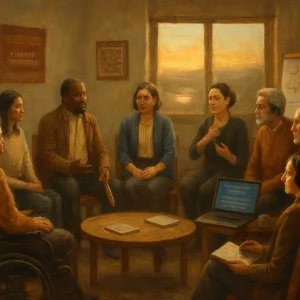
This topic presents practical methodologies and facilitation competencies required to design, convene and steward equitable and inclusive intercultural dialogues. It draws upon UNESCO’s framing of intercultural dialogue — “an equitable exchange … based on mutual understanding and respect and the equal dignity of all cultures” — and the scholarship and practice networks represented in the IDIU UNITWIN Network and the publication Interculturalism at the Crossroads. Materials and examples reference the UNESCO e‑Platform as a source of curated publications, case studies and tools.
Note: facilitators must respect and acknowledge local protocols and custodianship. In contexts referenced in this course, include a formal acknowledgement of Traditional Custodians and their ongoing connection to land, waters and communities as part of opening protocols.
I. Principles that guide dialogic facilitation
- Equal dignity: Organize interactions so all participants are treated with equal respect and their cultural identities are validated.
- Voluntary participation and informed consent: Participation is voluntary; participants understand purpose, format, confidentiality and potential risks.
- Safety and care: Create emotionally and physically safe spaces; apply trauma‑informed approaches where relevant.
- Reflexivity and humility: Facilitators practice cultural humility, reflect on power and positionality, and avoid imposing solutions.
- Transparency and accountability: Be explicit about goals, limits of the process, decision‑making pathways and follow‑up.
- Accessibility and inclusion: Attend to language access, physical accessibility, timing, gender inclusion and digital divides.
- Context sensitivity: Tailor methods to local norms, histories, conflict dynamics and legal/ethical constraints.
II. Core dialogic formats and when to use them
-
Structured Dialogue
- Description: Time‑bounded, rule‑governed conversations focused on a specific theme with equal speaking opportunities and guided prompts.
- Use when: Objective is mutual understanding, deliberation on public policy, or reducing polarisation around a specific issue.
- Typical mechanics: Ground rules, brief personal introductions, rotating speaking turns (e.g., talking piece), silent reflection breaks, facilitated summarising.
-
Storytelling and Narrative Exchange
- Description: Participants share first‑person narratives or community stories to convey lived experience and cultural meaning.
- Use when: The goal is empathy building, humanising “the other”, cultural learning, or truth‑telling in restorative processes.
- Typical mechanics: Prompted personal stories (time‑limited), listening exercises, creative responses (art, mapping), follow‑up contextualisation.
-
Mediated Exchange (Mediation & Facilitation Hybrid)
- Description: A neutral third party (mediator or cultural broker) manages asymmetric power relations and translates between different interpretive frameworks.
- Use when: Conflicting parties, significant power imbalances, legal or institutional stakes, or where language/cultural brokerage is required.
- Typical mechanics: Shuttle diplomacy or joint sessions, caucus options, mediated framing and re‑framing, use of interpreters/brokers.
-
Conversational Cafés (e.g., World Café)
- Description: Small rotating group conversations that cross‑pollinate ideas; harvests collective intelligence.
- Use when: Generating diverse perspectives, community engagement, idea mapping.
- Typical mechanics: Themed tables, rotation between tables, harvest with plenary synthesis.
-
Fishbowl
- Description: Inner circle engages while outer circle observes; roles rotate to encourage deep listening.
- Use when: Exposing group to concentrated perspectives, enabling observation of group dynamics.
- Typical mechanics: Clear timing, rotation signals, debrief for observers.
-
Appreciative Inquiry
- Description: Focus on strengths, successes and best practices to inspire collaborative solutions.
- Use when: Rebuilding relationships, designing culturally grounded programs, or shifting from blame to possibility.
- Typical mechanics: Discover–Dream–Design–Destiny phases with story prompted evidence.
-
Digital/Hybrid Dialogues
- Description: Online synchronous or asynchronous exchanges using platforms that allow breakout rooms, chat, polls.
- Use when: Participants are geographically dispersed or when physical convening is impractical.
- Typical mechanics: Pre‑session orientation on platform, accessibility supports (captions), clear moderation of chat, digital norms.
III. Facilitation techniques and tools
Preparation
- Stakeholder mapping: Identify who must be included, who is affected, and who holds power.
- Needs assessment: Gather information about language needs, accessibility, cultural protocols, and trauma triggers.
- Logistics and resources: Secure venues, interpreters, cultural liaisons, confidentiality agreements and follow‑up commitments.
- Co‑design: Where possible, co‑design agenda with community representatives or co‑facilitators.
Opening the space
- Land acknowledgement and cultural protocols appropriate to context.
- Clarify purpose, expected outcomes and limits.
- Negotiation of ground rules and group agreements (see sample below).
- Introduce facilitation roles: lead facilitator, note‑taker, timekeeper, cultural broker, safety officer.
Active listening techniques
- Paraphrasing and reflective summarising.
- Validating emotions: acknowledge feelings without necessarily endorsing positions.
- Use of “I” statements to ground personal experience and reduce generalized claims.
Question design
- Open, non‑leading prompts (e.g., “What experience led you to this view?”).
- Scaling and ranking questions to surface priorities (e.g., “On a scale of 1–5…”).
- Clarifying and probing questions to uncover context (e.g., “Can you say more about that?”).
Managing turn‑taking and power dynamics
- Use time limits and speaking tokens (e.g., talking piece).
- Implement small group rotations so marginalized voices have space.
- Offer multiple modes for contribution: spoken, written, visual, anonymous input.
Conflict and emotion management
- Name dynamics explicitly and neutrally.
- Offer short cooling‑off breaks.
- Use caucuses or private check‑ins for parties needing additional support.
- Bring in mediators or culturally appropriate elders where necessary.
Use of interpreters and cultural brokers
- Brief interpreters and brokers on neutrality expectations and confidential handling.
- Allow extra time for interpreted speech (double time).
- Use consecutive interpretation for sensitive content; simultaneous only if competence assured.
Visual and participatory tools
- Flipcharts, story maps, timeline exercises, cultural mapping, persona roleplays, photo elicitation.
- Digital tools: collaborative whiteboards, shared documents, anonymous polling.
Closing and follow‑up
- Harvest key themes and agree clear next steps.
- Provide summary notes in accessible languages and formats.
- Ensure mechanisms for accountability and feedback (surveys, follow‑up meetings).
IV. Competencies required for equitable and inclusive facilitation
Competencies are grouped into knowledge, skills, and attitudes. For each competency, observable behaviors are provided.
-
Cultural and contextual knowledge
- Knowledge: Local histories, cultural norms, religious sensitivities, and socio‑political dynamics.
- Observable behavior: References local protocols in opening; tailors methods to cultural norms.
-
Ethical and legal awareness
- Knowledge: Confidentiality, informed consent, child protection and privacy laws.
- Observable behavior: Secures consent forms; clarifies limits to confidentiality.
-
Active listening and communication skills
- Skills: Reflective listening, summarising, clear verbal facilitation.
- Observable behavior: Accurately paraphrases participants’ points and asks clarifying questions.
-
Conflict sensitivity and de‑escalation
- Skills: Neutral re‑framing, calming interventions, use of caucuses or structured mediation.
- Observable behavior: Intervenes before escalation; offers alternative formats to express dissent.
-
Power analysis and facilitation design
- Skills: Mapping power relations, designing inclusion mechanisms.
- Observable behavior: Allocates speaking time, proactively invites underrepresented participants to speak.
-
Language and interpretation management
- Skills: Working effectively with interpreters, accommodating multilingual environments.
- Observable behavior: Schedules extra time for interpretation and validates translated meaning.
-
Trauma‑informed practice
- Knowledge & skills: Recognising signs of distress, offering opt‑outs, referrals to services.
- Observable behavior: Provides content warnings and private support options.
-
Reflexivity and accountability
- Attitudes: Openness to feedback, willingness to acknowledge mistakes, continuous learning.
- Observable behavior: Seeks participant feedback and amends facilitation practice accordingly.
-
Group process design and choreography
- Skills: Choosing appropriate formats, time allocation, sequencing activities.
- Observable behavior: Runs sessions on time and aligns activities with objectives.
-
Digital facilitation competence
- Skills: Managing online platforms, ensuring accessibility (captions, low‑bandwidth options).
- Observable behavior: Provides multiple ways to contribute online and manages chat effectively.
V. Practical tools: Sample ground rules and session templates
Sample ground rules (co‑created with participants)
- Speak from your own experience; use “I” statements.
- Listen to understand, not to respond.
- Confidentiality: What is said here stays here, unless agreed otherwise.
- Assume good intentions; address harmful behavior with care.
- Respect speaking time; allow others to finish.
- Use interpreters and translators respectfully.
60–90 minute structured dialogue session (template)
- Opening (10–15 min)
- Land acknowledgement, welcome, objectives, co‑design note, ground rules.
- Warm‑up (10 min)
- Short listening exercise (paired “tell‐and‐listen” for 2–3 minutes each).
- Focused prompts (30–35 min)
- Three thematic prompts; round‑robin responses with time limits.
- Facilitator reflections after each round.
- Harvest and synthesis (15 min)
- Small groups generate 2–3 insights; plenary synthesises.
- Closing (5–10 min)
- Agree next steps, feedback mechanisms, offer support contacts.
Multi‑day dialogic workshop (3 days) — key design notes
- Day 1: Relationship and trust building; storytelling and cultural sharing.
- Day 2: Deep listening, structured deliberation, exposure to different perspectives.
- Day 3: Co‑creation of action steps, commitments and evaluation design.
- Integrate rest periods, optional one‑to‑one supports, and culturally appropriate ceremonies.
Virtual format adaptations
- Pre‑session technology check and orientation materials (video/text) translated as needed.
- Limit session length to 90 minutes with frequent breaks.
- Use breakout rooms for small group interactions and an accessible platform with captioning.
VI. Managing power, representation and inclusion
- Prior inclusion analysis: Check who is absent and why; consider outreach and compensation for participation (travel, childcare, honoraria).
- Seating and spatial design: Use circular seating to flatten hierarchy when possible; avoid podiums.
- Language parity: Offer materials and facilitation in relevant languages; hire community interpreters.
- Gender and intersectional inclusion: Provide gender‑safe spaces; be attentive to intersectional marginalisation.
- Representation vs tokenism: Ensure meaningful roles (co‑facilitation, agenda setting) for community representatives rather than symbolic presence.
VII. Monitoring, evaluation and indicators of equitable dialogue
Suggested indicators
- Participation equity: proportion of time spoken by demographic groups; number of unique speakers.
- Perceived safety: participant ratings on emotional safety and respect.
- Understanding gains: pre/post self‑assessments on knowledge of other perspectives.
- Relationship building: number of new intergroup contacts and commitments to follow‑up.
- Action orientation: clearly documented next steps with responsibilities.
Evaluation methods
- Mixed methods: short surveys (translated), facilitated debriefs, observation checklists and qualitative interviews.
- Include participant feedback on facilitation quality and cultural appropriateness.
- Use evaluation findings to revise facilitation processes and report back to participants.
VIII. Ethical considerations and risk mitigation
- Confidentiality limits: Define and communicate limits (e.g., mandatory reporting).
- Trauma and vicarious harm: Provide trigger warnings and referral pathways to support services.
- Data protection: Secure storage of audio recordings, written notes and personal information.
- Compensation and recognition: Fairly remunerate community knowledge holders, storytellers and interpreters.
- Exit strategy: Prepare for scenarios where dialogue may break down; ensure safety and restoration options.
IX. Learning activities and practice assignments (for LMS delivery)
- Practical assignment: Design a 90‑minute structured dialogue for a specified intercultural context (include objectives, agenda, ground rules, accessibility plan, and risk assessment). Peer review another student’s plan.
- Roleplay: In small groups, practice facilitator interventions in a simulated escalation. Swap roles: facilitator, participant, observer, cultural broker. Submit a short reflection.
- Reflection journal: Write two entries describing a time you felt unheard and one strategy a facilitator could have used to restore inclusion.
- Checklist completion: Use the facilitation checklist (provided in course resources) during a live or simulated session and submit annotated checklist.
X. Resources and further reading
- UNESCO e‑Platform on Intercultural Dialogue — curated resources, case studies and policy guidance.
- Interculturalism at the Crossroads (L’interculturalisme à la croisée des chemins) — edited volume with theoretical and practice perspectives from the IDIU Network.
- UNITWIN/IDIU Network publications on intercultural and inter‑religious dialogue.
- Practical guides on trauma‑informed facilitation, mediation ethics and digital inclusion (see course resource list for specific downloadable files).
Facilitation of intercultural dialogue is a skill set that combines rigorous process design with deep ethical grounding and ongoing reflexivity. Effective facilitators adapt methods to context, centre equal dignity, and prioritize safety and accountability so dialogue contributes to mutual understanding, social cohesion and actionable outcomes.
