


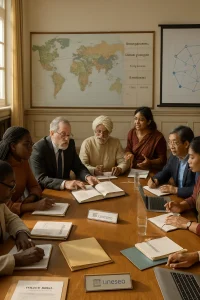
This lesson situates intercultural dialogue within its historical trajectories and the institutional architectures that have shaped its theory and practice. Building on UNESCO’s definition of intercultural dialogue as “an equitable exchange and dialogue among civilizations, cultures and peoples, based on mutual understanding and respect and the equal dignity of all cultures” (UNESCO, 33), we examine how transnational organisations, academic networks and policy instruments have generated the conceptual frameworks, normative commitments and operational modalities that practitioners and scholars employ today.
We foreground three complementary aims:
- to trace the historical development of international dialogue initiatives and their shifting rationales and forms;
- to clarify the roles, mandates and interactions of institutional actors—most notably UNESCO and the UNITWIN Network on Inter‑Religious Dialogue and Intercultural Understanding (IDIU Network)—in producing knowledge, convening actors and supporting practice; and
- to critically engage the bilingual volume Interculturalism at the Crossroads as both a scholarly synthesis and a practical resource that reflects debates at the intersection of interculturalism, multiculturalism, diversity governance and inter‑religious dialogue.
Lesson structure and topics
- Topic 1 — History of International Dialogue Initiatives
A concise genealogy of major international dialogue efforts, highlighting post‑war multilateralism, late‑20th century multicultural and human rights frameworks, and contemporary responses to global mobility and digital interconnectivity. - Topic 2 — UNITWIN Network and Institutional Actors
Examination of the UNITWIN (IDIU) Network’s composition, mandate and activities; the Inclusion, Rights and Dialogue Section within UNESCO; and the relationships among chairs, universities, policy units and civil society practitioners. - Topic 3 — Interculturalism at the Crossroads
Critical reading of the UNESCO–IDIU bilingual volume as a synthesis of theory and practice, with attention to contested concepts, methodological pluralism and implications for policy and grassroots programming.
Learning objectives
By the end of this lesson, participants will be able to:
- situate contemporary intercultural dialogue within its principal historical and institutional lineages;
- identify and compare the mandates, capacities and contributions of key institutional actors, including UNESCO and the IDIU Network;
- assess the aims, scope and critical perspectives advanced in Interculturalism at the Crossroads; and
- apply institutional and historical insight to evaluate or design dialogue initiatives that are attentive to equity, inclusion and cultural dignity.
Key resources (selected)
- UNESCO e‑Platform on Intercultural Dialogue — curated publications, best‑practice case studies and a searchable bibliography (global knowledge hub).
- Interculturalism at the Crossroads (L’INTERCULTURALISME À LA CROISÉE DES CHEMINS) — bilingual volume produced in collaboration with the IDIU Network.
- UNITWIN Network (IDIU) webpages and the UNESCO Chair for Cultural Diversity and Social Justice at Deakin University — network descriptions, resources and scholarly links.
Guiding questions for study and reflection
- How have historical moments (e.g., decolonization, international human rights development, migration flows) shaped the objectives and modalities of intercultural dialogue initiatives?
- In what ways do institutional structures (UNESCO, UNITWIN/IDIU, university chairs) enable or constrain equitable dialogue practices?
- What tensions and complementarities emerge from the perspectives assembled in Interculturalism at the Crossroads, and how might these inform context‑sensitive programming?
Note on institutional commitment and acknowledgement
This lesson draws upon materials maintained by the UNESCO Chair for Cultural Diversity and Social Justice at Deakin University and resources developed under the UNITWIN/UNESCO Chairs Programme. As a demonstration of institutional commitment to inclusion and respect for place, we acknowledge the Traditional Custodians of the lands on which Deakin University operates and pay respect to their Ancestors and Elders, past and present. These acknowledgements are integral to practising intercultural dialogue that recognises historical responsibilities and the dignity of all cultural traditions.
