


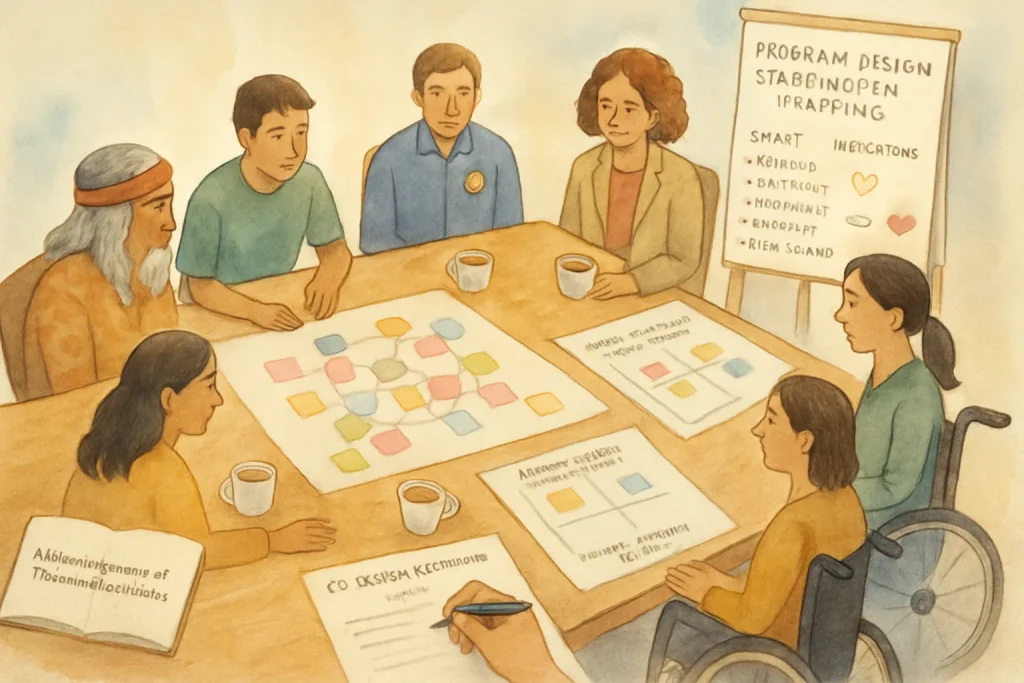
Lesson: Designing, Implementing, and Sustaining Dialogue Initiatives
This topic provides practical templates and step‑by‑step processes to design intercultural dialogue programs and to map, engage and co‑design with stakeholders. It is grounded in UNESCO’s definition of intercultural dialogue and draws on resources available through the UNESCO e‑Platform and the UNITWIN/IDIU Network, including the bilingual volume Interculturalism at the Crossroads (L’interculturalisme à la croisée des chemins). Materials emphasize inclusion, recognition of Traditional Custodians, ethical engagement and alignment of objectives with social cohesion goals.
Learning outcomes
- Conduct a contextually sensitive needs assessment for an intercultural dialogue initiative.
- Produce a stakeholder map that identifies roles, interests, capacities and power relations.
- Apply a co‑design process that respects community protocols and recognises Traditional Custodians.
- Formulate SMART objectives aligned with social cohesion and derive measurable indicators.
- Design an engagement and monitoring plan that supports sustainability and ethical practice.
1. Framing principles
- UNESCO framing: Intercultural dialogue is “an equitable exchange … based on mutual understanding and respect and the equal dignity of all cultures” — objectives should reflect equity, dignity and social cohesion.
- Rights‑based, participatory and culturally respectful approaches are non‑negotiable. Engagement must be reciprocal and attentive to power imbalances.
- Recognise and formally acknowledge Traditional Custodians of the land and any Indigenous protocols in all stages of program design and delivery.
- Use the UNESCO e‑Platform and IDIU Network publications as evidence bases and sources of good practice and case studies.
2. Needs assessment: process and template
Purpose: Establish the rationale for the intervention, identify priority issues and baseline conditions, and ensure design reflects community needs and capacities.
Stepwise process
- Preparatory desk review
- Review UNESCO e‑Platform resources, Interculturalism at the Crossroads, local policy documents, demographic data, and prior evaluations.
- Stakeholder scoping (rapid)
- Identify obvious groups (e.g., community leaders, local government, NGOs, faith organisations, schools) for initial contact.
- Design mixed methods data collection
- Key informant interviews, focus group discussions, short household/community surveys, and participatory tools (e.g., problem ranking, seasonal calendars).
- Fieldwork with cultural protocols
- Seek permission from Traditional Custodians; use language translators where necessary; ensure gender and age diversity in participation.
- Analysis and validation
- Triangulate findings, prepare a summary, and validate results in feedback sessions with stakeholder representatives.
- Recommendation and prioritisation
- Produce practical, time‑bound recommendations for program objectives and activities.
Needs assessment template (summary)
- Title of assessment:
- Geographic and cultural scope:
- Date(s):
- Purpose and key questions:
- Sources reviewed (desk):
- Methods used (interviews, FGDs, surveys, participatory methods):
- Key findings (social cohesion risks/opportunities):
- Vulnerable or under‑represented groups identified:
- Local capacities and assets:
- Cultural protocols and Traditional Custodians to acknowledge:
- Risks and mitigation strategies:
- Recommended priorities for program design (short list):
- Validation actions taken (dates/participants):
Activity suggestion: As a class exercise, use the UNESCO e‑Platform to compile a short desk review and draft the “Key findings” section for a hypothetical city with recent migration inflows.
3. Stakeholder mapping: methods and template
Purpose: Identify who matters to the initiative, their interests and influence, and design appropriate engagement strategies.
Core methods
- Listing and classification: Create a comprehensive list of actors across sectors (community, civil society, faith groups, education, private sector, local government, media, funders, police, health).
- Power–interest matrix: Plot stakeholders by level of interest in the initiative and level of influence/power.
- Relationship mapping: Visualise formal and informal networks, alliances and potential points of friction.
- Capacity and risk assessment: Identify which stakeholders can support delivery, which may resist, and potential leverage points.
- Inclusion analysis: Assess representation of women, youth, minority groups, migrants, and Traditional Custodians.
Stakeholder mapping template (matrix)
- Stakeholder name / group
- Sector / affiliation
- Role or function vis‑à‑vis dialogue initiative
- Interests and expectations
- Capacity (resources, skills)
- Influence (high/medium/low) — formal and informal
- Attitude to initiative (supportive/neutral/opposed)
- Potential contribution
- Risks or concerns
- Engagement strategy (how, by whom, when)
- Communication needs (language, format, channels)
- Contact person / liaison
Example (excerpt)
- Stakeholder: Local Indigenous Elders Council
- Sector: Traditional Custodians / community leadership
- Role: Cultural authority, land custodianship, gatekeepers to ceremonial protocol
- Interests: Respectful recognition, protection of cultural knowledge, appropriate benefit sharing
- Capacity: High cultural authority, limited administrative resources
- Influence: High (community legitimacy)
- Attitude: Conditional support (depends on respect for protocols)
- Potential contribution: Guidance on protocols, co‑design of ceremonies, cultural content
- Risk: Cultural appropriation or tokenism
- Engagement strategy: Early consultation, formal acknowledgement, co‑created Memorandum of Understanding (MoU)
- Communication needs: Face‑to‑face meetings, time for consultation, interpreters if required
- Contact: [Name/role]
Power–Interest Matrix: use to prioritise engagement
- High power / high interest: actively involve and collaborate.
- High power / low interest: keep satisfied; brief periodically.
- Low power / high interest: empower and involve in participatory roles.
- Low power / low interest: monitor; provide information.
Practical tip: Revisit the map at least quarterly; stakeholder attitudes can shift quickly during politically sensitive moments.
4. Co‑design with communities (including recognition of Traditional Custodians)
Principles for co‑design
- Prior consent and protocol: Before any design activity, formally acknowledge Traditional Custodians and seek permission according to local protocols.
- Reciprocity: Design must produce tangible benefits to participating communities and not only serve external agendas.
- Shared governance: Establish advisory committees or a community steering group with meaningful decision‑making authority.
- Capacity strengthening: Budget for training and resources so community partners can participate on equal terms.
- Transparency: Clarify roles, expectations, resource flows and intellectual property arrangements.
- Iteration: Use pilot activities and iterative feedback loops; document adaptations.
Co‑design process (phases)
- Establish a community advisory group (CAG) that includes Traditional Custodians, youth, women, faith and civil society representatives.
- Co‑define problems and desired outcomes using participatory facilitation techniques (world café, story circles).
- Co‑develop activities and selection criteria for participants; identify cultural protocols and safe spaces.
- Draft a co‑design agreement or MoU that records commitments, decision‑making processes, budgets and recognition clauses (e.g., land acknowledgment script).
- Pilot core activities with co‑facilitation by community partners; collect feedback.
- Iterate and finalise the program plan; embed continuous feedback mechanisms.
Co‑design agreement template (key clauses)
- Parties (including Traditional Custodians)
- Purpose and scope of collaboration
- Principles (respect, reciprocity, confidentiality, free/ prior/ informed consent)
- Roles and responsibilities
- Decision‑making processes (voting, consensus)
- Resource allocation and compensation for community time
- Cultural protocols and acknowledgement procedures
- Data ownership and use of cultural material
- Conflict resolution mechanisms
- Duration and review dates
- Signatures and witnesses
Ethical note: Compensate community partners fairly for time and expertise. Avoid one‑off consultations; seek long‑term partnerships.
5. Setting objectives aligned with social cohesion goals
Link objectives to UNESCO’s social cohesion ambitions: reduction of discrimination, increased mutual understanding, strengthened trust across groups, and institutional changes that support inclusion.
Framework: From high‑level social cohesion goals to program objectives and indicators
- Social cohesion goal (example): Strengthen mutual understanding and trust between recent migrants and long‑term residents.
- Program objective (SMART): Within 12 months, increase reported intergroup trust between migrant and resident participants by 20% as measured by a validated intergroup trust scale in pre/post surveys.
- Output indicators: 1) Number of cross‑community dialogue sessions held (target: 12); 2) Number of participants representing both groups (target: 240; 50% female).
- Outcome indicators: 1) Change in intergroup trust score (baseline and endline); 2) Percentage of participants reporting increased willingness to collaborate on local issues.
- Impact indicators (longer term): 1) Reduction in reported intergroup incidents in local media/police records; 2) Adoption of a joint community action plan by local council.
- Program objective (SMART): Within 12 months, increase reported intergroup trust between migrant and resident participants by 20% as measured by a validated intergroup trust scale in pre/post surveys.
SMART objectives template
- Objective statement:
- Specific: Who will change, what will change?
- Measurable: What indicators will show change?
- Achievable: Is the target realistic given resources?
- Relevant: How does it align with social cohesion goals?
- Time‑bound: What is the timeframe?
- Baseline data:
- Target(s):
- Indicators (output, outcome, impact):
- Data sources and collection methods:
- Responsible persons:
Indicator examples relevant to social cohesion
- Quantitative: number of intercultural events, participant diversity index, pre/post scores on attitudes (e.g., intergroup trust), number of joint initiatives launched.
- Qualitative: participant narratives of mutual understanding, case studies of reduced discrimination, documented policy changes.
- Process indicators: degree of community representation in steering committee, percentage of activities co‑facilitated by Traditional Custodians.
Practical guidance: Combine quantitative scales with qualitative narratives to capture subtle changes in attitudes and practices.
6. Engagement strategies and communications
Tailor communications to stakeholder needs:
- Community meetings and story circles for oral cultures.
- Multilingual written materials for diverse language groups.
- Social media and local radio for youth and wider reach.
- Formal briefings and policy briefs for local government and funders.
Engagement cadence
- Foundational phase: intensive consultations and co‑design.
- Implementation phase: regular co‑facilitation and monthly check‑ins.
- Consolidation phase: handover, capacity transfer and sustainability planning.
Communication planning template (brief)
- Audience:
- Key messages:
- Channel(s):
- Frequency:
- Lead person:
- Accessibility considerations (language, format, time of day):
7. Monitoring, evaluation and sustainability
M&E essentials
- Baseline: collect before activities commence (surveys, interviews, observational checklists).
- Midline and endline: measure progress against SMART targets.
- Participatory M&E: involve community partners in data collection and reflection workshops.
- Learning loops: schedule regular reflection sessions to adapt program design.
- Data protection: ensure confidentiality and culturally appropriate handling of data, with explicit consent.
Sustainability actions
- Build local capacity (training facilitators, documentation).
- Establish local governance (community steering group with a clear mandate).
- Diversify funding streams (local government, philanthropic, social enterprise models).
- Document procedures and create open access resources on results and methods (consistent with UNESCO e‑Platform sharing norms).
- Plan a transition/handover including maintenance resources and timelines.
M&E template (core elements)
- Indicator:
- Baseline value:
- Target value:
- Data collection method:
- Frequency:
- Responsible actor:
- Notes on disaggregation (gender, age, ethnicity, migration status):
8. Risk assessment and mitigation
Common risks
- Tokenistic engagement or cultural appropriation.
- Elite capture (only powerful stakeholders dominate).
- Political backlash or security incidents.
- Language barriers and exclusion of non‑literate participants.
- Unsustainable dependency on external funding.
Mitigation measures
- Use clear co‑design agreements and equitable compensation.
- Actively recruit under‑represented groups and monitor representation.
- Establish security protocols and contingency plans.
- Provide translation and alternative communication formats.
- Embed capacity building and explore local revenue models.
9. Ethical considerations and obligations to Traditional Custodians
- Acknowledge Traditional Custodians in all public materials and at events; follow locally agreed wording and practice.
- Ensure free, prior and informed consent for use of cultural knowledge or imagery.
- Offer appropriate cultural protocols, including ceremony where appropriate and agreed.
- Respect intellectual property and communal knowledge rights — agree use and attribution in writing.
- Pay attention to gender, youth and generational dynamics within Indigenous and other communities.
10. Recommended readings and resources
- UNESCO e‑Platform on Intercultural Dialogue — curated publications, case studies and bibliographic resources.
- Interculturalism at the Crossroads (L’interculturalisme à la croisée des chemins) — thematic chapters on theory and practice.
- Select scholarly articles available via the UNESCO e‑Platform and IDIU Network (e.g., work by UNITWIN/IDIU partners).
- Local legal and policy documents relating to Indigenous rights and community consent.
11. Practical exercises (for learners)
- Desk review task: Using the UNESCO e‑Platform, compile a 1‑page context brief for a selected locality (demographics, recent tensions/opportunities, key policies).
- Stakeholder mapping workshop: In small groups, create a stakeholder matrix for the locality; produce a power–interest map and identify three priority engagement strategies.
- Co‑design role play: Simulate a meeting with Traditional Custodians and municipal officials to negotiate an MoU; prepare a one‑page co‑design agreement.
- Objective setting: Draft three SMART objectives for a one‑year pilot and propose measurable indicators.
12. Quick checklist for program designers
- [ ] Completed desk review referencing UNESCO e‑Platform resources.
- [ ] Conducted culturally appropriate needs assessment with participatory methods.
- [ ] Produced stakeholder map and power–interest matrix.
- [ ] Established community advisory group including Traditional Custodians.
- [ ] Drafted co‑design agreement/MoU and compensation plan.
- [ ] Set SMART objectives aligned to social cohesion goals, with indicators.
- [ ] Developed M&E plan with baseline measures and participatory processes.
- [ ] Incorporated sustainability and capacity transfer strategy.
- [ ] Documented ethical protocols and data protection procedures.
Endnote: Effective intercultural dialogue programming rests on rigorous context analysis, transparent and inclusive stakeholder engagement, formal recognition of Traditional Custodians, and measurable objectives that advance social cohesion. Use UNESCO’s e‑Platform and the IDIU Network outputs as continuously updated references for theory, methods and best‑practice case studies.
