


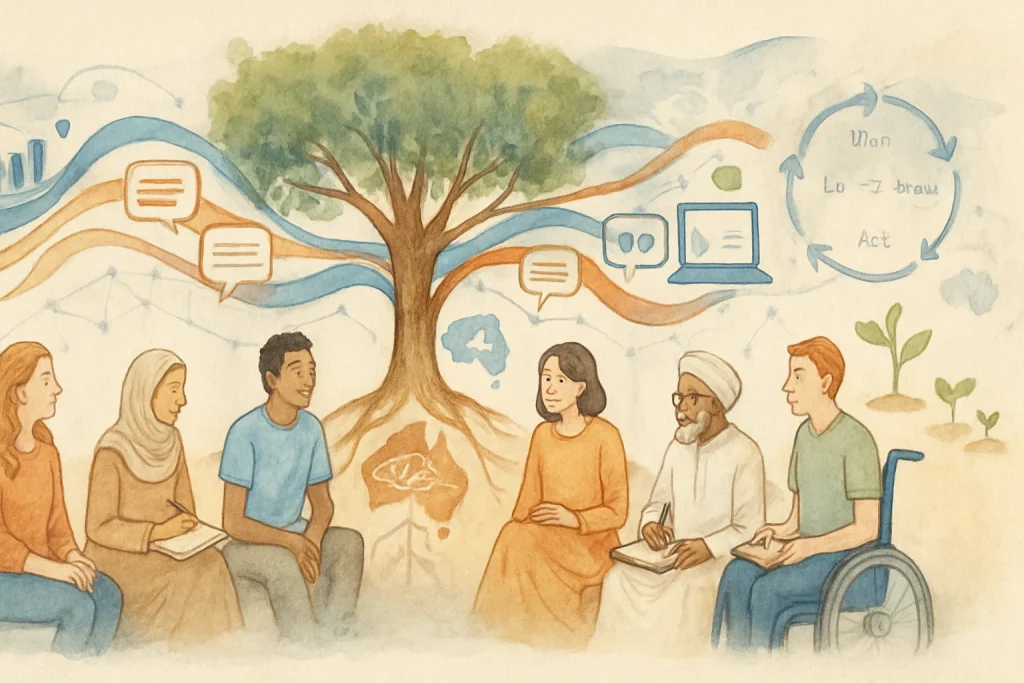
(Lesson: Designing, Implementing, and Sustaining Dialogue Initiatives)
Overview
Monitoring, learning, and adaptive management (MLAM) are central to designing and sustaining intercultural dialogue initiatives that are effective, equitable, and contextually responsive. MLAM comprises systematic monitoring of activities and outcomes, deliberate learning processes that surface evidence and insights, and structured mechanisms for adapting interventions in response to new knowledge. In the context of the UNITWIN Network on Inter‑Religious Dialogue and Intercultural Understanding (IDIU Network), UNESCO’s e‑Platform and the UNESCO Chair for Cultural Diversity and Social Justice at Deakin University provide critical infrastructure for dissemination, peer learning, and institutional memory.
This topic outlines a practical MLAM system tailored to intercultural dialogue initiatives, covering indicators and methods, participatory monitoring practices, iterative decision-making processes, knowledge management, dissemination strategies through UNESCO/IDIU networks, and ethical considerations including acknowledgement of Traditional Custodians.
Guiding principles
- Respect and dignity: MLAM must embody UNESCO’s principle of the equal dignity of all cultures; monitoring practices should avoid imposing external value judgments that undermine participants’ agency.
- Participation and co-ownership: Communities and stakeholders should co‑design monitoring questions, indicators, and interpretation of findings.
- Context-sensitivity: Methods and adaptations should reflect local cultural norms, languages, and power relations.
- Equity and inclusion: Ensure marginalized voices are represented in data collection, analysis, and decision-making.
- Transparency and accountability: Share methods, findings, and adaptations openly with stakeholders and funders.
- Continual learning and humility: Treat interventions as hypotheses to be tested and refined.
Core components of an MLAM system
-
Purpose and Learning Questions
- Define why you are monitoring and what you want to learn.
- Example learning questions:
- How do participants from different cultural or religious backgrounds experience safety and mutual respect within the dialogue space?
- Which facilitation approaches most effectively reduce mistrust and foster sustained collaboration?
- What structural barriers limit participation of underrepresented groups, and how can they be removed?
-
Theory of Change (ToC) and Indicators
- Articulate a clear, context-specific ToC linking activities to outcomes and long-term impacts (e.g., social cohesion, reduced prejudice).
- Develop indicators across levels:
- Inputs: resources, staff training hours, number of outreach events.
- Outputs: number of dialogues held, diversity of participant demographics, materials produced.
- Outcomes (short/medium): changes in intergroup attitudes, trust levels, collaborative initiatives formed.
- Impact (long-term): indicators of reconciliation, policy change, reduced incidents of discrimination.
- Use mixed indicators (quantitative + qualitative) to capture depth and nuance.
-
Data Collection Methods
- Quantitative: structured surveys, attendance registers, pre/post measures of attitudes.
- Qualitative: in‑depth interviews, focus groups, participant observation, narrative collection, oral histories.
- Participatory methods: community scorecards, outcome mapping, most significant change.
- Digital tools: mobile surveys, online feedback forms, social network analysis for mapping relationships.
- Frequency: combine continuous monitoring (e.g., session feedback) with periodic evaluations (mid-term, end-line).
-
Roles, Responsibilities and Governance
- Clarify who collects data, who analyses it, who makes adaptation decisions, and who communicates results.
- Include community representatives in monitoring committees or advisory groups.
- Establish safeguards for data protection and ethical review.
-
Analysis and Learning Processes
- Regular reflection cycles (e.g., monthly learning reviews, quarterly reflection workshops).
- Use simple templates for reflection: What did we plan? What happened? Why? What will we change?
- Triangulate across data sources and perspectives to reduce bias.
- Ensure findings are translated into actionable recommendations with timelines and assigned responsibility.
-
Adaptive Management Mechanisms
- Define decision triggers and thresholds that prompt adaptation (e.g., attendance below X% or recurring safety concerns).
- Establish rapid response protocols for emergent issues (conflict escalation, safeguarding incidents).
- Use iterative cycles (Plan–Do–Study–Act / Assess–Adapt) to test changes and scale successful adaptations.
- Document all changes and rationales to maintain institutional memory.
Participatory monitoring: methods and best practice
- Co-design indicators with participants, including culturally appropriate measures of trust and dignity.
- Use facilitators or evaluators who are culturally fluent or from participant communities.
- Schedule safe spaces for candid feedback, ensuring anonymity where needed.
- Balance power dynamics: enable marginalized participants to speak privately to independent evaluators.
- Validate findings with participant groups before external dissemination.
Knowledge management and institutional memory
To sustain institutional learning and support replication across the IDIU Network and beyond:
-
Documentation standards
- Maintain a central repository (digital and backed-up) for protocols, ToCs, monitoring tools, data sets (with metadata), reports, and lessons learned.
- Use standard file naming, version control, and metadata (who, what, when, location, language).
-
Archiving and accessibility
- Archive raw and processed datasets with clear access permissions and safeguards.
- Provide summaries and translations appropriate to participant languages and literacy levels.
- Ensure alignment with data sovereignty principles and community consent.
-
Knowledge products
- Produce diverse outputs: short case studies, policy briefs, facilitator guides, video summaries, and bibliographies that connect to the UNESCO e‑Platform and the bilingual volume Interculturalism at the Crossroads.
- Use multimedia to reach different audiences (podcasts, recorded webinars, infographics).
-
Communities of Practice and Peer Learning
- Foster bilateral exchange across UNITWIN/IDIU chairs via thematic working groups, regular webinars, and peer review of evaluations.
- Maintain a searchable bibliography and repository of case studies (linking to the UNESCO e‑Platform) to promote reuse and cross‑site learning.
-
Institutional memory practices
- Conduct “handover” briefings for staff turnover, including a curated set of core documents and key learnings.
- Store institutional histories (e.g., timelines, decision logs) to explain why certain adaptations were made.
Dissemination via UNESCO Chair and UNITWIN/IDIU networks
Strategies to amplify learning and support policy uptake:
-
Formal channels:
- Upload curated case studies, monitoring tools, and methodological notes to the UNESCO e‑Platform and the UNESCO Chair’s resource pages.
- Submit policy briefs and peer-reviewed articles to networks and journals referenced in Interculturalism at the Crossroads.
-
Network activities:
- Present findings in IDIU Network seminars and UNITWIN network meetings for peer feedback.
- Facilitate cross-site learning exchanges and mentorship pairings between newer and more established chairs.
-
Public and practitioner outreach:
- Host webinars and workshops for practitioners, with recordings and Q&A transcripts archived.
- Produce short, accessible policy briefs for decision-makers and community leaders.
- Engage social media and network newsletters for rapid sharing of outcomes and invitations to collaborative learning events.
-
Translation and cultural adaptation:
- Provide summaries in relevant local languages and bilingual formats consistent with the multilingual commitments of the IDIU Network.
Ethical considerations and acknowledgement of Traditional Custodians
- Acknowledge and respect Traditional Custodians of lands where work is undertaken; incorporate local protocols for consultation and permission.
- Obtain informed consent for monitoring and dissemination; respect requests for anonymity or restricted use.
- Be sensitive to cultural norms for knowledge sharing—some knowledge may be sacred, gendered, or restricted.
- Ensure data protection and consider cultural data sovereignty—explicitly specify who may use, access, and store data.
- Avoid extractive practices: ensure communities benefit from findings and that outputs are returned in useful formats.
Practical tools and templates (summaries)
-
Sample indicator template
- Indicator: Percentage of participants reporting increased trust in cross‑cultural interactions (short term)
- Type: Outcome
- Measurement: Pre/post survey using validated scale
- Data source: Participant surveys
- Frequency: Before first session; after 6 months
- Responsible: Monitoring lead + community co‑researcher
-
Learning review template (monthly)
- Objective reviewed
- What happened (evidence)
- Why it happened (analysis)
- Implications for design/facilitation
- Action(s) to take, responsible person, timeline
-
Adaptation decision log (minimum fields)
- Date
- Trigger (data, stakeholder feedback, external event)
- Proposed change
- Rationale
- Decision (approved/declined)
- Implementation date
- Follow up/evaluation plan
-
Dissemination checklist
- Draft case study (500–1,000 words) completed
- Executive summary (1 page) for policymakers
- Materials translated into local languages
- Submission to UNESCO e‑Platform/IDIU Network repository
- Webinar scheduled and recorded
- Feedback solicited from participant communities prior to publication
Common pitfalls and how to avoid them
- Pitfall: Monitoring that prioritises donor reporting over local learning.
- Avoidance: Co‑develop indicators; keep a balance between accountability metrics and locally meaningful learning questions.
- Pitfall: Overreliance on quantitative measures that miss cultural nuance.
- Avoidance: Complement with qualitative methods and narrative collection.
- Pitfall: Failure to act on learning.
- Avoidance: Establish clear decision-making protocols and assign responsibility for implementing adaptations.
- Pitfall: Dissemination without community consent.
- Avoidance: Validate findings with communities and obtain permissions before public sharing.
Capacity building for MLAM
- Train facilitators and local monitoring officers in mixed-methods data collection, participatory evaluation, and ethical standards.
- Offer mentoring via UNITWIN/IDIU partner chairs to strengthen skills in evaluation design and knowledge translation.
- Use the UNESCO e‑Platform as a repository for training materials and templates.
Suggested further reading and resources (select)
- UNESCO e‑Platform on Intercultural Dialogue — global repository of publications, case studies, and tools.
- Interculturalism at the Crossroads (bilingual volume) — theoretical and practical perspectives from the IDIU Network.
- Resources and repository maintained by the UNESCO Chair for Cultural Diversity and Social Justice at Deakin University (includes network news, bibliographies, and acknowledgment of Traditional Custodians).
Concluding note
Effective MLAM transforms intercultural dialogue initiatives from static programs into adaptive, learning organisations that centre dignity, inclusion, and local ownership. By embedding participatory monitoring, systematic learning cycles, robust knowledge management, and purposeful dissemination through the UNESCO Chair and IDIU/UNITWIN networks, practitioners can ensure that dialogue initiatives remain responsive to changing contexts and capable of generating sustained social impact.
