

Designing, Implementing, and Sustaining Dialogue Initiatives

Jukka 2.9.2025
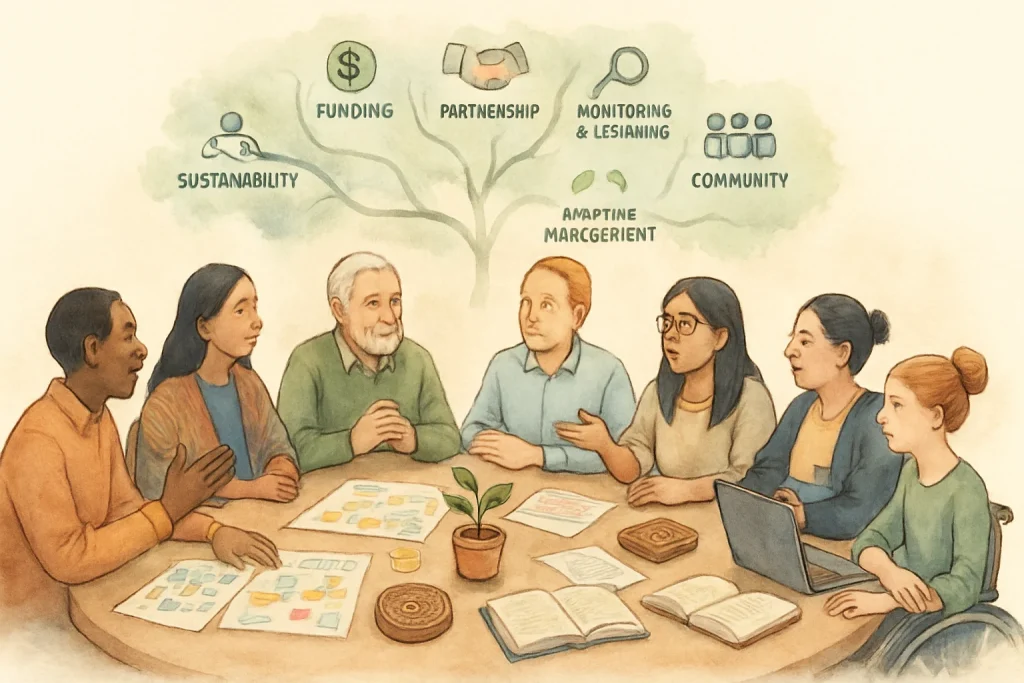
This lesson addresses the practical and conceptual processes required to design, implement, and sustain intercultural dialogue initiatives across diverse social and institutional contexts. Grounded in UNESCO’s definition of intercultural dialogue—an equitable exchange based on mutual understanding, respect, and the equal dignity of all cultures—the lesson brings together theoretical insights and applied tools drawn from the UNITWIN/IDIU Network and the bilingual volume Interculturalism at the Crossroads. It also draws on curated materials from UNESCO’s e‑Platform on Intercultural Dialogue and resources maintained by the UNESCO Chair for Cultural Diversity and Social Justice at Deakin University, which reflect commitments to inclusion and the formal acknowledgement of Traditional Custodians.
Purpose
- Equip practitioners, policymakers, and scholars with actionable frameworks and methods to operationalize dialogue projects.
- Foster competent stakeholder engagement, robust funding and partnership strategies, and sustainable monitoring and learning systems.
- Emphasise culturally appropriate practice and local custodianship in all stages of programme development.
Learning objectives
By the end of this lesson, participants will be able to:
- Apply stakeholder mapping and programme‑design methodologies to articulate objectives, target constituencies, and expected outcomes for intercultural dialogue initiatives.
- Assess options for scale, funding, and institutional partnerships, and construct partnership models that are ethically grounded and operationally feasible.
- Design monitoring, learning, and adaptive management plans that promote accountability, evidence‑informed adjustment, and long‑term sustainability.
Lesson structure
This lesson is organised into three sequential topics:
- Program Design and Stakeholder Mapping — conceptual models, needs assessment, participatory design methods, and power analysis for equitable engagement.
- Scale, Funding, and Institutional Partnerships — funding streams and sustainability models, scaling strategies, and governance arrangements with civil society, academic, and state actors.
- Monitoring, Learning, and Adaptive Management — indicators and mixed methods for impact assessment, mechanisms for iterative learning, and approaches to adaptive management in dynamic contexts.
Pedagogical approach
- Integrative: each topic combines theoretical readings (including contributions from the IDIU Network and Interculturalism at the Crossroads) with case studies from UNESCO’s e‑Platform to illustrate best practice and pitfalls.
- Applied: participants will engage in practical exercises (e.g., stakeholder maps, partnership proposals, monitoring frameworks) to translate concepts into implementable plans.
- Reflective and critical: emphasis on ethical considerations, context sensitivity, and reflexivity, including recognition of historical inequalities and contemporary forms of marginalisation.
Practical considerations and assessment
- Participants are expected to produce a concise dialogue initiative brief as a formative assessment: problem statement, stakeholder map, proposed partners and funding strategy, and a monitoring and adaptive management outline.
- Discussion forums will be used to peer‑review proposals and to surface contextual variations and governance challenges.
Respect, inclusion, and custodianship
Consistent with the commitments of UNESCO and the IDIU Network, this lesson foregrounds respect for cultural difference and the equal dignity of all participants. Materials and activities mandate the acknowledgement of local custodianship where projects are located and require engagement practices that respect Indigenous protocols and community consent. The resources curated by the UNESCO Chair at Deakin University provide guidance on honouring these responsibilities in practice.
Key resources (selected)
- UNESCO e‑Platform on Intercultural Dialogue — global hub for publications, case studies, and best practices.
- Interculturalism at the Crossroads / L’interculturalisme à la croisée des chemins — multidisciplinary essays and practice‑oriented chapters from the IDIU Network.
- Publications and resource lists maintained by the UNESCO Chair for Cultural Diversity and Social Justice (Deakin University).
Proceed to Topic 1: Program Design and Stakeholder Mapping to begin applying these frameworks to concrete contexts.
