


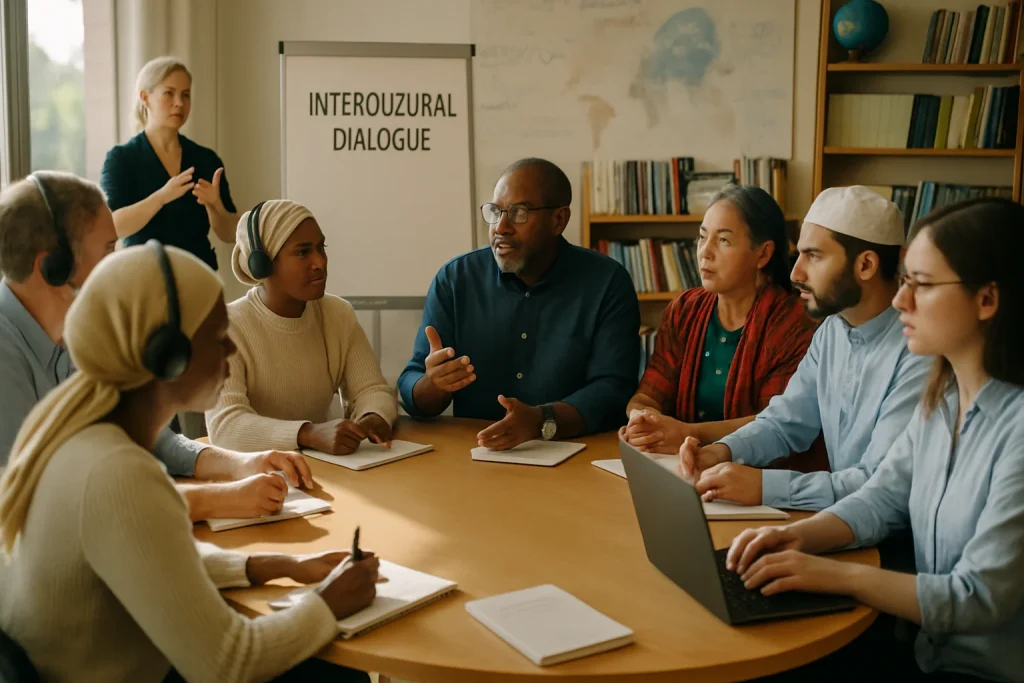
This topic examines the conceptual core of "intercultural dialogue" as articulated by UNESCO and elaborated within the UNITWIN/IDIU Network and related scholarship. It situates UNESCO’s working definition—grounded in mutual understanding, respect, and the equal dignity of cultures—alongside adjacent concepts (multiculturalism, interculturalism, and pluralism), highlighting similarities, differences and the implications of each for policy and practice.
UNESCO’s definition: core elements and implications
UNESCO characterises intercultural dialogue as "an equitable exchange and dialogue among civilizations, cultures and peoples, based on mutual understanding and respect and the equal dignity of all cultures" (UNESCO). The Organisation further locates intercultural dialogue as "the essential prerequisite for constructing social cohesion, reconciliation among peoples and peace among nations." Key components include:
-
Equitable exchange
- Dialogue must be reciprocal and mindful of power asymmetries; it is not merely a one-way transmission of information.
- Equity requires attention to access, voice and recognition for all participants.
-
Mutual understanding
- Emphasises efforts to comprehend other cultural frames, histories and worldviews.
- Goes beyond tolerance to cognitive and affective engagement with difference.
-
Respect
- Involves valuing others’ rights, practices and perspectives even when disagreement persists.
- Requires norms and behaviours that protect dignity in interaction.
-
Equal dignity of all cultures
- Rejects hierarchical valuations of cultures; asserts the normative parity of cultural identities.
- Supports policies and practices that recognise and affirm cultural worth.
Practical implications of UNESCO’s framing:
- Intercultural dialogue is normative and programmatic: it informs education, governance, conflict resolution and community practice.
- It demands institutional supports (e.g., inclusive policy frameworks, resources, capacity-building) and attention to structural inequalities that impede equitable exchange.
- It links cultural recognition to broader goals of social cohesion, human rights and sustainable peace.
The UNITWIN Network on Inter-Religious Dialogue and Intercultural Understanding (IDIU Network) and the bilingual volume Interculturalism at the Crossroads exemplify the integration of scholarship and practice that UNESCO promotes. The UNESCO e-Platform on Intercultural Dialogue functions as a curated repository of publications, a searchable bibliography and a set of best-practice case studies that illustrate how the definition is operationalised across contexts.
Contrasting related concepts
Intercultural dialogue overlaps with, but is distinct from, other approaches to cultural diversity. Below are concise definitions, orientations and critical distinctions.
-
Multiculturalism
- Definition: A descriptive and normative orientation recognising the coexistence of multiple cultural groups within a society and often advocating state recognition of cultural rights.
- Orientation: Rights- and recognition-based; focuses on representation, anti-discrimination and institutional accommodation (e.g., language rights, affirmative measures).
- Typical policy forms: Legal protections, group-specific provisions, cultural funding, minority rights frameworks.
- Critiques: Can entrench difference without fostering interaction; may treat groups as bounded and static; risks cultural relativism if not coupled with shared civic values.
-
Interculturalism
- Definition: Emphasises interaction, exchange and the construction of shared meanings across cultural boundaries.
- Orientation: Relational and dialogic; foregrounds processes of encounter, mutual learning and negotiation of differences.
- Typical policy forms: Community dialogue initiatives, intercultural curricula, mediating institutions that facilitate contact across groups.
- Distinctive strengths: Focuses on contact and relationship-building; addresses social cohesion directly.
- Critiques: May insufficiently address structural inequality unless explicitly attentive to power; can be constrained by superficial forms of "dialogue" that avoid difficult issues.
-
Pluralism
- Definition: A broader normative stance affirming the legitimacy of diverse beliefs, values and lifestyles within a polity, and seeking to manage their coexistence through toleration and institutional pluralism.
- Orientation: Political-philosophical; emphasises tolerance, legal frameworks, and the regulation of public life to accommodate diversity.
- Typical policy forms: Constitutional protections for freedom of religion and belief, anti-discrimination legislation, pluralist governance structures.
- Critiques: Tends toward procedural accommodation rather than fostering substantive intergroup relations; may not promote deep mutual understanding.
Comparative analysis — axes of difference
The distinctions among these concepts can be mapped along several analytical axes:
-
Interaction vs coexistence
- Intercultural dialogue and interculturalism prioritise interaction; multiculturalism and pluralism may emphasise coexistence and institutional recognition.
-
Normative focus
- Multiculturalism: recognition and rights.
- Intercultural dialogue/interculturalism: relational equality, mutual learning.
- Pluralism: toleration and non‑interference.
-
Treatment of power
- Intercultural dialogue (as defined by UNESCO) explicitly requires equitable exchange and therefore attention to power asymmetries.
- Multiculturalist policies sometimes formalise difference without redressing structural inequalities.
- Pluralist frameworks can sidestep unequal power relations in favour of procedural neutrality.
-
Policy orientation
- Multiculturalism often yields legal and institutional remedies.
- Intercultural dialogue informs educational, community-based and deliberative practices.
- Pluralism shapes constitutional and administrative safeguards for diversity.
Relationship to inter‑religious dialogue and diversity governance
Intercultural dialogue, as promoted by the IDIU Network, operates at the intersection of cultural and religious plurality. Inter-religious dialogue complements intercultural approaches by focusing on faith-based identities and their contributions to public life. Effective diversity governance integrates:
- Legal protections (pluralism/multiculturalism),
- Deliberative and relationship-focused programs (intercultural dialogue/interculturalism), and
- Structural measures addressing inequality and discrimination.
The IDIU Network’s collaborative research and practice-oriented projects exemplify how academic chairs and practitioners can co-produce interventions that are sensitive to both doctrinal differences and socio-political power relations.
Operationalising UNESCO’s definition in practice
To translate the definition into programs and policies, practitioners should attend to several considerations:
-
Equity and access
- Ensure marginalised voices have equal opportunity to participate in dialogues; provide resources, translation and culturally appropriate facilitation.
-
Power awareness
- Identify and mitigate power imbalances (historical, economic, institutional) that distort "equitable exchange."
-
Context specificity
- Design dialogue initiatives responsive to local histories, colonial legacies and the particularities of intergroup relations (including recognition of Traditional Custodians and Indigenous rights).
-
Measurable outcomes
- Define indicators for mutual understanding, respect and dignity (e.g., changes in attitudes, participation rates, policy shifts, conflict reduction).
-
Capacity-building
- Train facilitators, educators and policymakers in intercultural communication, conflict sensitivity and inclusive curriculum design.
-
Integration with broader governance
- Couple dialogue initiatives with legal protections and anti-discrimination measures to ensure sustainability.
Practical settings where intercultural dialogue has been applied include education (intercultural curricula), community reconciliation processes, state–religious community consultations, and cross-sector partnerships addressing migration and displacement. The UNESCO e-Platform provides case studies that illustrate these applications and the challenges encountered.
Reflective questions for learners
- How does the requirement of "equal dignity" shape the design of a dialogue initiative compared with a program that simply promotes "tolerance"?
- In what situations might a multicultural policy be necessary but insufficient without intercultural dialogue? Provide concrete examples.
- How can facilitators identify and mitigate power asymmetries in intercultural dialogue processes?
- How does recognition of Indigenous peoples and Traditional Custodians intersect with UNESCO’s definition of intercultural dialogue?
Recommended resources
- UNESCO e-Platform on Intercultural Dialogue — curated publications, best-practice case studies and a searchable scholarly bibliography.
- Interculturalism at the Crossroads (L’interculturalisme à la croisée des chemins) — bilingual volume produced with contributions from the UNITWIN (IDIU) Network addressing theory and practice.
- UNITWIN Network on Inter-Religious Dialogue and Intercultural Understanding (IDIU Network) — for research projects and collaborative initiatives linking scholarship to practice.
- Selected scholarly literature available via the UNESCO-hosted bibliography and the UNESCO Chair for Cultural Diversity and Social Justice at Deakin University (including work by Mansouri, Elias & Sweid on the “equal dignity” formulation).
Acknowledgement: In line with the commitments reflected in materials maintained by the UNESCO Chair for Cultural Diversity and Social Justice at Deakin University, practitioners and learners should recognise and honour the Traditional Custodians of the lands on which their work takes place, and incorporate culturally appropriate protocols into intercultural dialogue initiatives.
End of topic. In the next topic we will examine theoretical critiques of intercultural dialogue and methodological approaches for evaluating dialogue initiatives.
