


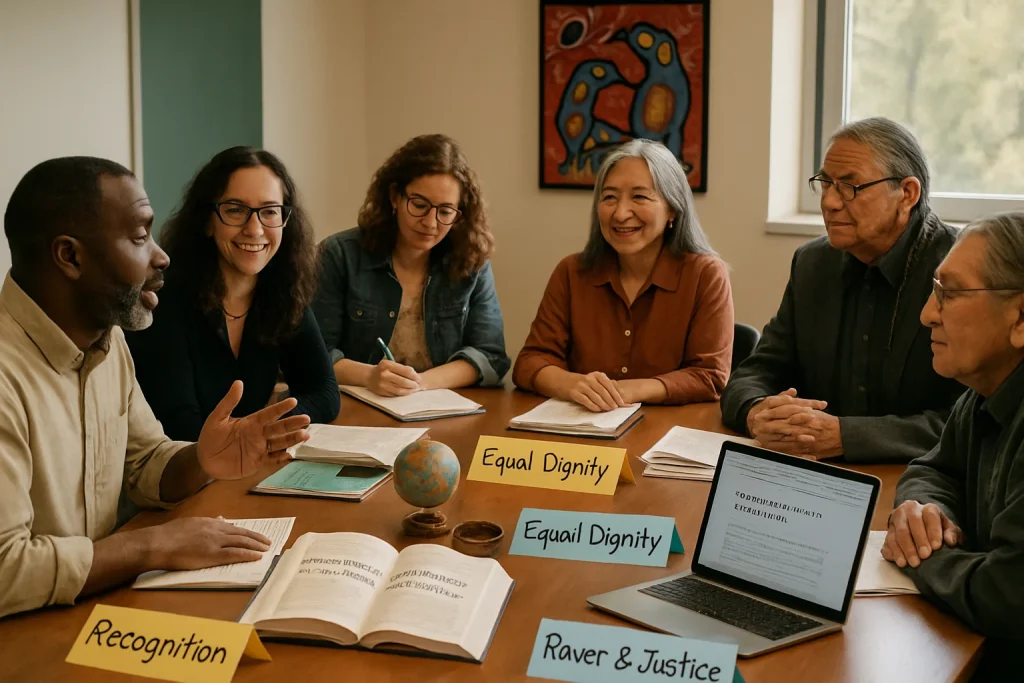
This lesson establishes the conceptual foundations necessary for rigorous study and effective practice in intercultural dialogue. Drawing on multidisciplinary scholarship produced by the UNITWIN Network on Inter‑Religious Dialogue and Intercultural Understanding (IDIU Network), the bilingual volume Interculturalism at the Crossroads (L’interculturalisme à la croisée des chemins), and the curated resources of UNESCO’s e‑Platform on Intercultural Dialogue, the lesson interrogates core definitions, situates competing and complementary theoretical frames, and examines the ethical and normative commitments that give intercultural dialogue social and political force.
UNESCO defines intercultural dialogue as “an equitable exchange and dialogue among civilizations, cultures and peoples, based on mutual understanding and respect and the equal dignity of all cultures,” and locates it as an essential prerequisite for social cohesion, reconciliation, and peace. This lesson unpacks that definition and explores its implications for theory, policy and practice across settings marked by cultural difference, inequality, or conflict.
Learning objectives
- Clarify and critically evaluate leading definitions of intercultural dialogue, and distinguish intercultural dialogue from related concepts (e.g., multiculturalism, interculturalism, inter‑religious dialogue).
- Map and appraise principal theoretical frameworks used to analyse intercultural relations, encounters, and processes of recognition and exclusion.
- Examine the ethical, normative and political commitments that underpin intercultural dialogue, including questions of power, dignity, rights and justice.
- Apply conceptual tools to interpret case studies and UNESCO e‑Platform materials so as to inform equitable, context‑sensitive practice.
Lesson structure and topics
- Topic 1 — Defining Intercultural Dialogue: Definitions, scope, terminological distinctions, and operationalisation for research and practice. We will interrogate UNESCO’s formulation alongside competing formulations found in the IDIU Network scholarship and Interculturalism at the Crossroads.
- Topic 2 — Theoretical Frameworks: Plural approaches drawn from political theory, sociology, cultural studies, and comparative religious studies. Frameworks include recognition theory, contact theory, critical multiculturalism, interculturalism, and dialogic ethics.
- Topic 3 — Ethics and Normativity: Normative foundations and ethical dilemmas—equal dignity, reciprocity, power imbalances, inclusion and exclusion, and the responsibilities of institutions and practitioners.
Required resources and recommended readings
- Interculturalism at the Crossroads (English/French) — key chapters assigned for each topic.
- Selected entries and case studies from UNESCO’s e‑Platform on Intercultural Dialogue — used to connect conceptual discussion with best‑practice examples and policy guidance.
- Curated scholarly bibliography maintained by the UNESCO Chair for Cultural Diversity and Social Justice (Deakin University) — for further study.
Learning activities and assessment
- Close readings and guided discussion of assigned texts from the IDIU Network and UNESCO materials.
- Short analytical reflections that apply theoretical tools to UNESCO case studies.
- A summative brief that critically assesses how one normative principle (e.g., equal dignity) might be operationalised in a specified intercultural setting.
Acknowledgement
We acknowledge the Traditional Custodians of the unceded lands and waterways on which this material was developed and the ongoing contributions of First Nations Peoples to our learning communities. Participants are encouraged to engage respectfully with local histories and protocols when applying intercultural dialogue practices.
This lesson provides the conceptual scaffolding for subsequent lessons on methods and practice. You are encouraged to consult the UNESCO e‑Platform and Interculturalism at the Crossroads resources as you progress through each topic.
