

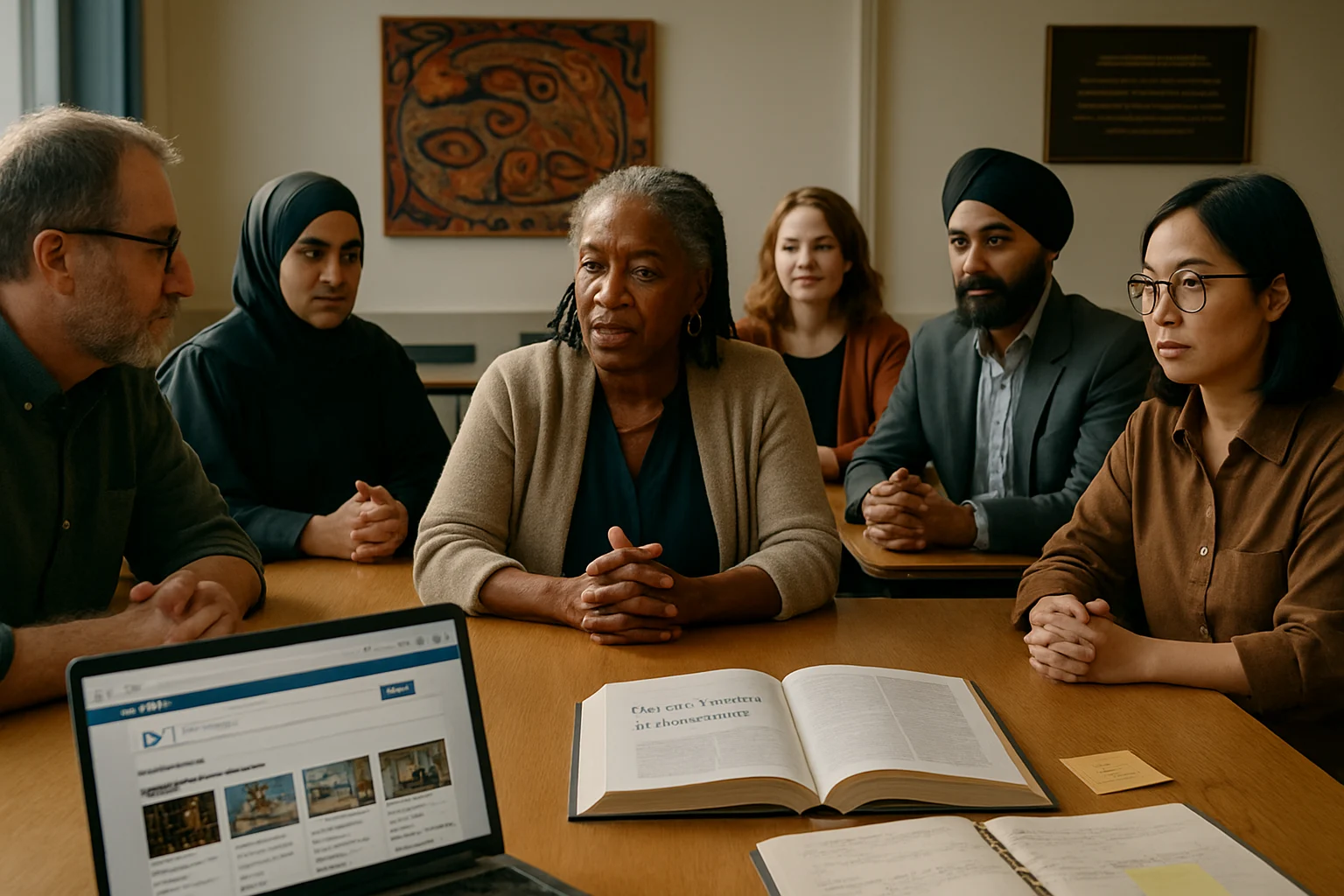
Intercultural Dialogue: Theory and Practice

This is a DEMO course to Mobie OnEdu LMS is done (fast) by AI (GhatGTP 5mini) and Jukka in the UNESCO Paris seminar from the website: Interculturalism Resources – UNESCO-UNITWIN IDIU.
Thank you, Professor Fethi Mansouri, for this session!
This multidisciplinary course provides a rigorous introduction to the conceptual foundations and applied methods that enable equitable exchange among civilizations, cultures, and peoples. Grounded in UNESCO’s definition of intercultural dialogue as “mutual understanding, respect, and equal dignity,” the course integrates scholarship from the UNITWIN Network on Inter‑Religious Dialogue and Intercultural Understanding and the bilingual volume Interculturalism at the Crossroads. Practical engagement with UNESCO’s e‑Platform — a curated repository of publications, a searchable scholarly bibliography, and best‑practice case studies — complements materials maintained by the UNESCO Chair for Cultural Diversity and Social Justice at Deakin University, which reflect commitments to inclusion and a formal acknowledgement of Traditional Custodians.
Course aims
- To introduce conceptual frameworks and key debates that define intercultural dialogue as an academic field and a professional practice.
- To situate contemporary intercultural initiatives within their historical, political, and institutional contexts.
- To present methodological approaches and practical tools for designing, facilitating, evaluating, and sustaining dialogue initiatives.
- To familiarize participants with the UNESCO e‑Platform and other digital resources as repositories of research evidence and exemplars.
- To enable participants to design contextually appropriate, ethically grounded, and sustainable dialogue interventions.
Intended learning outcomes
By the end of the course participants will be able to:
- Explain foundational concepts and theoretical approaches to intercultural dialogue, including principles of reciprocity, dignity, and inclusion.
- Analyze historical and institutional influences that shape contemporary practices in intercultural exchange.
- Select and apply appropriate qualitative and participatory methodologies for dialogue facilitation and evaluation.
- Navigate and utilize the UNESCO e‑Platform and related scholarly resources to inform practice and policy.
- Design a practicable dialogue initiative that is culturally sensitive, ethically defensible, and institutionally sustainable.
Course structure
The course is organised into five sequential lessons:
Conceptual Foundations of Intercultural Dialogue
— Definitions, normative principles (including UNESCO’s formulation), comparative theoretical perspectives, and key terminologies.Historical and Institutional Contexts
— Historical trajectories, legal and policy frameworks, the role of international organisations (including UNITWIN), and the relationship between intercultural dialogue and social justice.Methodologies and Practical Tools
— Participatory, deliberative, and conflict‑sensitive methods; facilitation techniques; ethical considerations; monitoring and evaluation frameworks.Resources and Digital Platforms: UNESCO e‑Platform
— Guided exploration of the e‑Platform’s repository, searchable bibliography, and curated case studies; strategies for resource synthesis and knowledge mobilisation.Designing, Implementing, and Sustaining Dialogue Initiatives
— Project design, stakeholder engagement, funding and institutionalisation strategies, risk assessment, and sustainability planning.
Learning activities and assessment
- Interactive readings and guided engagement with primary sources from the UNESCO e‑Platform and the UNITWIN Network.
- Case study analyses and critical reflections on best practice exemplars.
- Practical assignments, including a facilitation plan and a capstone project proposing a dialogue initiative with an implementation and evaluation plan.
- Peer review and formative feedback to develop reflective practice and collaborative competence.
Audience and prerequisites
This course is suitable for graduate students, practitioners in the fields of education, cultural policy, peacebuilding, community engagement, and professionals working in multicultural and inter‑religious contexts. No formal prerequisites are required, although prior familiarity with basic concepts in cultural studies, international relations, or social sciences will be advantageous.
Duration and delivery
The course is designed for flexible delivery over a term (typically 6–10 weeks) and can be adapted for intensive workshop formats. Instruction combines asynchronous study materials, synchronous seminars or webinars, and applied project work.
Inclusion and acknowledgement
Course materials and pedagogical approaches prioritise inclusion, cultural humility, and respect for diverse knowledges. Consistent with the commitments of the UNESCO Chair for Cultural Diversity and Social Justice at Deakin University, the course includes a formal acknowledgement of Traditional Custodians of the lands on which teaching and learning may take place, and encourages participants to recognise and respect Indigenous sovereignties, epistemologies, and custodial responsibilities.
Core resources (selected)
- UNESCO’s statements and framework documents on intercultural dialogue.
- Publications and outputs from the UNITWIN Network on Inter‑Religious Dialogue and Intercultural Understanding.
- Interculturalism at the Crossroads (bilingual volume).
- UNESCO e‑Platform: curated publications, searchable bibliography, and best‑practice case studies.
- Materials and guidance from the UNESCO Chair for Cultural Diversity and Social Justice, Deakin University.
This course aims to equip participants with both the theoretical insight and the practical competencies necessary to contribute meaningfully to equitable, respectful, and sustainable intercultural dialogue initiatives across diverse settings.
Course Content
About Instructor

Course Includes
- 5 Lessons
- 15 Topics
