


Lesson: Teachers as Facilitators of Learning
Topic: Facilitation vs. Traditional Teaching
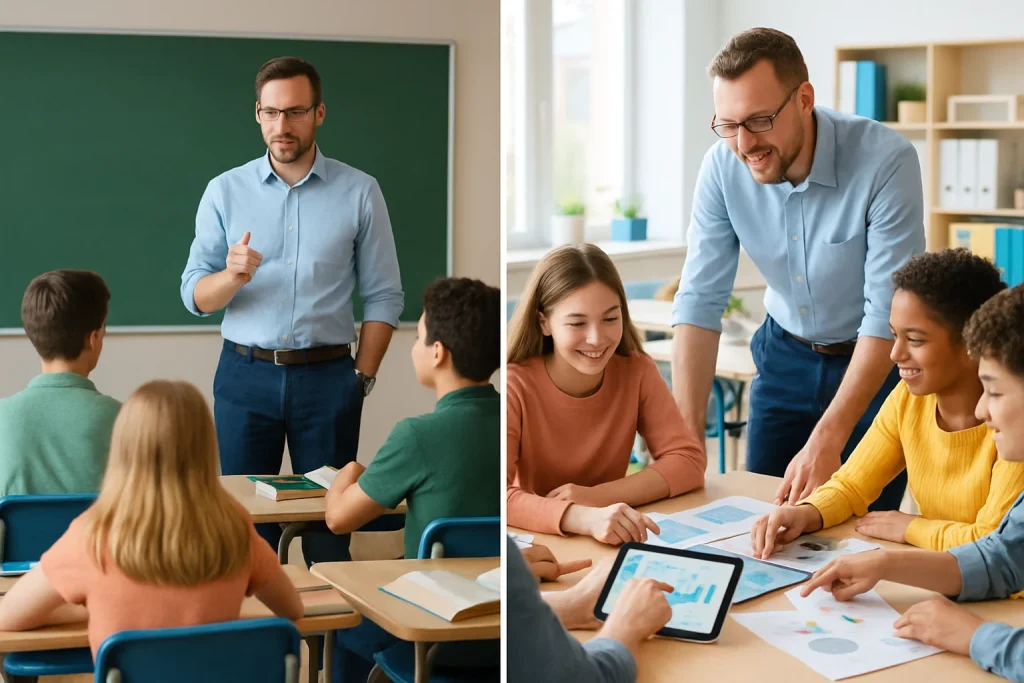
The educational landscape is constantly evolving, necessitating a shift from conventional teaching methodologies towards more innovative and student-centered approaches. This topic delves into the contrasts between facilitation techniques and traditional teaching methods, particularly in the context of Finnish education, which champions student-centered learning.
Traditional Teaching Methods
Traditional teaching, often termed as direct or didactic instruction, is characterized by a teacher-centered approach where the educator serves as the primary source of knowledge. Key features include:
-
Content Delivery: The teacher is responsible for delivering content, primarily through lectures and direct explanations. This is often supported by textbooks, which dominate lesson structures.
-
Passive Learning: Students are typically passive recipients of information, expected to absorb and memorize content with limited opportunities for interaction or inquiry.
-
Fixed Curriculum: The curriculum tends to be standardized and rigid, often focusing on rote memorization and adherence to prescribed objectives that may neglect the individual needs of students. As highlighted in the context provided, "Textbook is not the curriculum," indicating a tendency to rely heavily on fixed materials that may not cater to diverse learning conditions.
-
Assessment Focus: Evaluation is primarily conducted through standardized testing and assessments that prioritize recall of information over application or critical thinking.
Facilitation Techniques
In contrast, facilitation techniques, especially those emphasized in Finnish education, promote a student-centered learning environment. The primary characteristics of this approach include:
-
Active Engagement: In a facilitative learning environment, the teacher acts as a guide or facilitator rather than a mere transmitter of knowledge. Students are encouraged to engage actively with the material through discussions, group work, and collaborative tasks.
-
Personalized Learning: Facilitation thrives on adapting learning experiences to meet individual student needs. The emphasis on customized curricula and teaching in special education, as noted, reflects an understanding that "teaching and, if necessary, curricula must be adapted to the learning conditions of pupils."
-
Critical Thinking and Inquiry: The focus shifts from finding answers to posing meaningful questions. As pointed out, "In learning, questions are more important than answers," highlighting the importance of inquiry-based learning in facilitating deeper understanding and exploration.
-
Flexible Curriculum: Finnish educational practices emphasize a dynamic, flexible curriculum that evolves based on assessment feedback, changing environments, and the interests of students. This contrasts sharply with the more static nature of traditional educational models.
-
Holistic Development: Facilitation techniques prioritize the development of social skills, judgment, empathy, and overall well-being. As the teaching content integrates real-life skills necessary for the 21st-century learner, students are more prepared for a rapidly changing world.
Key Contrasts in Approach
| Aspect | Traditional Teaching | Facilitation Techniques |
|—————————|——————————————–|——————————————-|
| Role of Teacher | Content delivery; source of knowledge | Guide; supports and facilitates learning |
| Role of Student | Passive recipient of knowledge | Active participant in learning |
| Curriculum Flexibility | Rigid and standardized | Dynamic and adaptable |
| Learning Focus | Memorization | Critical thinking and inquiry |
| Assessment Criteria | Standardized tests focused on recall | Ongoing assessments based on feedback |
| Social Skills Development | Limited focus on interpersonal skills | Holistic approach to social and emotional development |
Implications for Special Education
The Finnish education system recognizes the diversity of student needs, particularly within special education contexts. When integration is not feasible or effective for a student’s development, specialized teaching arrangements are made. This incorporates customized curricula that align with the principles of facilitation, supporting students in becoming self-directed learners who monitor and evaluate their own learning process.
In conclusion, the transition from traditional teaching methods to facilitation techniques reflects a broader commitment to fostering a student-centered learning environment that values inquiry, adaptability, and holistic development. By embracing these approaches, educators can respond more effectively to the unique needs of their students, ultimately preparing them for success in an increasingly complex world.
