


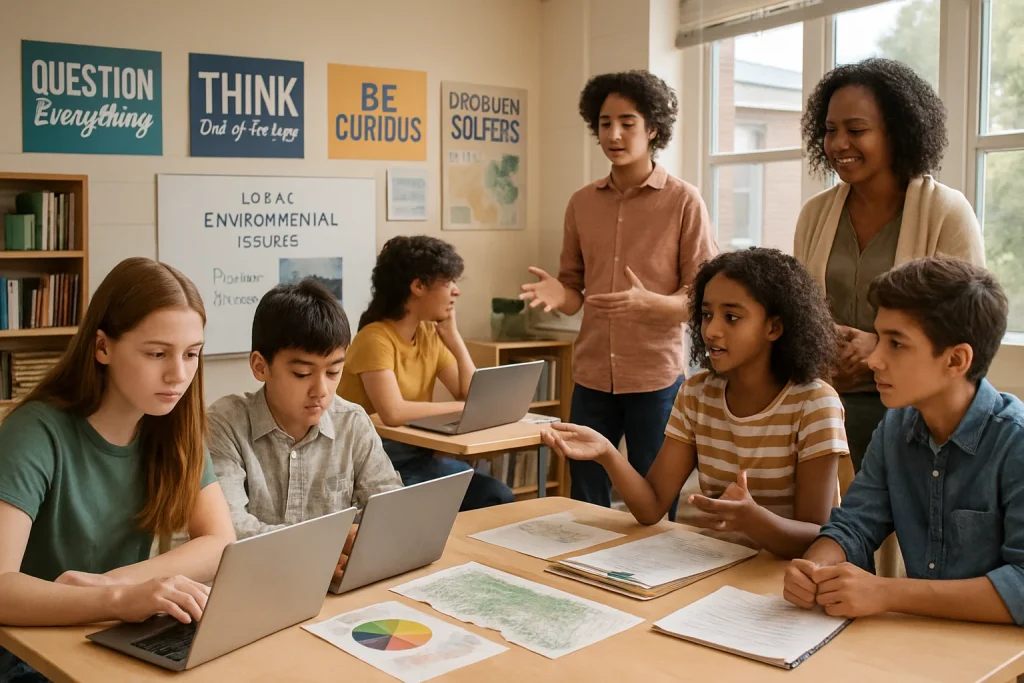
Introduction to Critical Thinking in Education
In the framework of Finnish education, nurturing critical thinking skills is paramount. Critical thinking involves the cognitive processes by which students actively analyze, evaluate, and synthesize information to form reasoned judgments. This contrasts with rote learning, where students merely memorize facts without understanding their relevance or application. As such, fostering critical thinking is not only about enhancing academic skills but also about preparing students for real-world challenges.
Methods to Foster Critical Thinking and Problem-Solving Skills Among Students
-
Encourage Inquiry-Based Learning
Inquiry-based learning places students at the center of the learning process, making them active participants in their education. In this model, students are encouraged to ask questions, hypothesize solutions, conduct experiments, and draw conclusions based on evidence. This method helps them develop skills such as information gathering and analysis, which are essential for critical thinking.
- Practical Application: Initiate a project that requires students to solve a real-world problem, like a local environmental issue. Students should investigate, collect data, and propose solutions based on their findings.
-
Integrate Problem-Oriented Tasks
Problem-oriented tasks foster a learning environment where students must engage with realistic scenarios. These tasks should begin with concrete situations that are relatable, enabling students to apply mathematical concepts to their everyday lives, rather than just performing calculated procedures mechanically.
- Practical Application: Utilize mathematics to address community issues such as budgeting for a school event or calculating resources needed for a community garden. This contextualizes their learning and connects mathematical concepts to real-world application.
-
Facilitate Group Discussions and Collaborative Learning
Group discussions create a platform for students to articulate their thoughts and challenge one another’s perspectives. This collaborative environment enhances critical thinking because students must consider alternative viewpoints and justify their reasoning.
- Practical Application: Organize debates on relevant topics, encouraging students to research various sides of an argument and present their findings to their peers. Evaluation of arguments will refine their analytical abilities.
-
Emphasize Reflective Practices
Reflection helps students internalize their learning experiences, allowing them to assess what strategies worked well, where they faced challenges, and how they can improve in the future. Reflection can take various forms, such as journaling, peer feedback, or self-assessment.
- Practical Application: After completing a project or a significant task, prompt students to write reflective essays that address what they learned, how they approached challenges, and what they might do differently next time.
-
Utilize Technology Wisely
Technology can be an effective tool in fostering critical thinking. Using calculators or computers should not replace thinking; rather, they should be integrated as supportive tools that aid in problem-solving and not as crutches that diminish logical reasoning skills.
- Practical Application: Have students use software for data analysis in projects, enabling them to visualize and interpret data while making informed decisions based on their analysis.
-
Foster an Environment of Continuous Feedback
An essential component of nurturing critical thinking is providing consistent, constructive feedback. Feedback should guide students on how to improve their thinking processes and outcomes.
- Practical Application: Create a feedback loop wherein students can critique both their work and their peers’ work. Encourage them to provide specific suggestions for improvement, thus developing their evaluative skills.
Conclusion
The Finnish educational system posits that nurturing critical thinking and problem-solving abilities in students is fundamentally about more than just acquiring knowledge; it’s about intertwining learning with meaningful life skills that will serve students in their future endeavors. By employing varied strategies to encourage inquiry, collaboration, reflection, and the sensible use of technology, educators can cultivate critically thinking individuals capable of navigating the complexities of a rapidly changing world. Through this holistic approach, students learn to perceive learning as an integrative process where their knowledge is continuously refined and expanded.
