


Overview
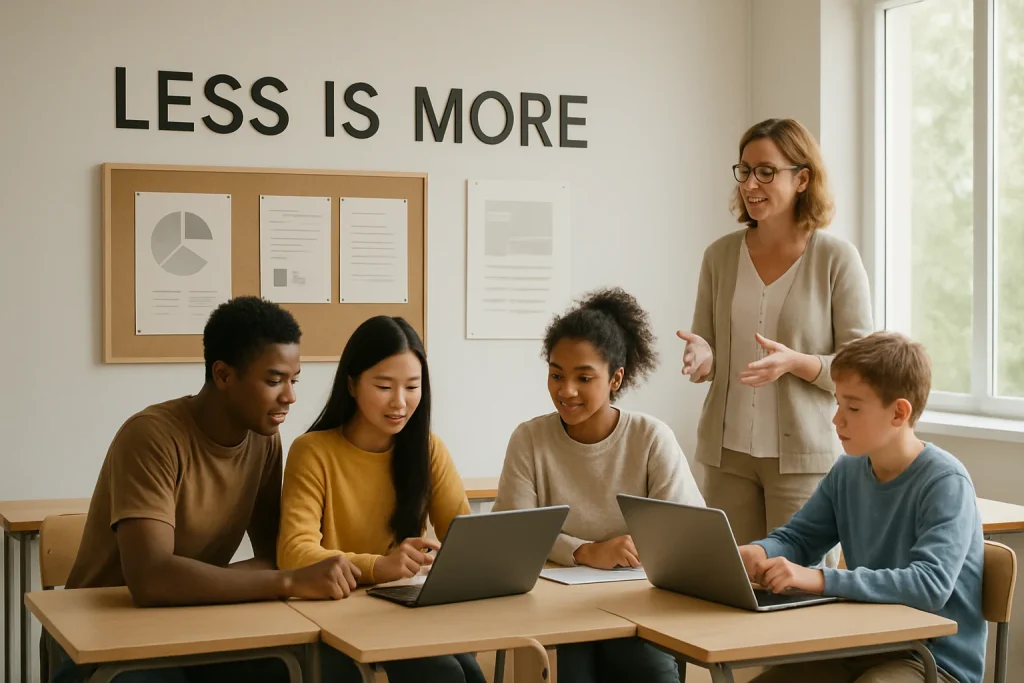
The philosophy of "Less is More" emphasizes the efficiency and effectiveness of prioritizing streamlined content in education, resonating deeply with the Finnish educational approach. This principle underscores a significant shift in teaching methodology, especially in light of the evolving requirements of the 21st-century learning environment. In Finland, where educational reforms emphasize student-centered learning, the alignment of curriculum content with real-life skills proves to be essential.
The Need for Streamlined Content
In the context of 21st-century education, students are immersed in a technical and virtual environment. They require skills that are relevant and applicable to real-world situations. The rise of information technology has transformed how knowledge is processed; rather than memorizing facts, students are guided to retrieve relevant information "Just In Time (JIT)" from digital sources, such as search engines and online databases. This paradigm shift necessitates a reevaluation of what constitutes essential learning content.
-
Focus on Real-Life Skills: The new educational landscape prioritizes competencies such as creative thinking, collaboration, communication, and creativity. Consequently, it is crucial for educators to curate and streamline the curriculum, emphasizing skills that genuinely prepare students for their future endeavors.
-
Cutting Unnecessary Content: To facilitate effective learning, educators must cut excess content from standardized textbooks. The adage "Textbook is not the Curriculum" resonates here, as it drives home the idea that learning should extend beyond what is merely inscribed in textbooks. Teachers are encouraged to assess the relevance of learning materials systematically.
The Three-Question Method
In Finland, a practical approach to curriculum planning utilizes the three-question method to help teachers focus on essential content:
-
WHAT?: Teachers must identify the core topics within the curriculum and ascertain the most critical learning outcomes for lessons. This requires educators to filter out superfluous content that does not contribute meaningfully to students’ understanding or real-world applicability.
-
WHY?: After determining what to teach, it is essential to understand why this knowledge matters. Instead of focusing solely on information for exams, educators are encouraged to engage students with why the content is relevant to their future career pathways and personal growth. If the subject matter does not add value to the students’ lives, it may be appropriate to omit it from the lessons.
-
HOW?: Lastly, educators must plan lessons that actively support the learning process, fostering engagement and linking material to real-life contexts. Effective teaching strategies stimulate student participation and initiate discussions that deepen understanding of practical applications.
Redefining Lesson Structure
Traditional lecture formats have often hindered student engagement, with research indicating that the majority of students struggle to maintain focus during lengthy teaching sessions. Therefore, lesson structures should pivot towards motivation, interactivity, and reflection. An effective lesson might include:
-
Motivation: Clearly articulate the relevance of the lesson and how it connects to students’ lives. Utilizing stories, videos, and relatable examples can motivate students to engage with the material.
-
Summary of Teaching Content: Present key concepts within a concise timeframe to maintain attention, limiting direct instruction to roughly 10 minutes.
-
Student Activation: Facilitate active learning through collaboration, group work, and experiential tasks that encourage students to inquire and explore.
-
Reflection: Allow students to articulate their learning experiences, share insights, and pose questions, reaffirming their understanding and addressing any ambiguities.
-
Repetition: Conclude with a recap of essential points, reinforcing retention of knowledge and its practical applications.
Challenges and Opportunities
While the transition to a more streamlined curriculum presents challenges — such as potential pushback from traditional perspectives on education — it also opens doors to innovative teaching practices. It requires educators to embrace their role as facilitators of learning, shifting from being mere transmitters of knowledge to enabling environments that foster inquiry, creativity, and collaboration.
Conclusion
In summary, the "Less is More" philosophy, as exemplified by the Finnish education model, champions focused learning that prioritizes relevant content and fosters essential real-life skills. By streamlining lessons and emphasizing student-centered methodologies, educators can significantly enhance the quality of education, preparing students more effectively for the complexities of the modern world. Embracing these practices offers an opportunity to create a more dynamic, engaging, and supportive learning environment for all students.
