


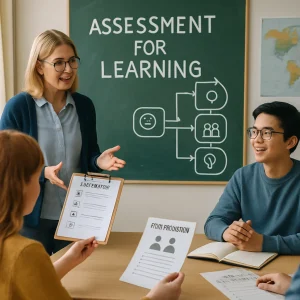
Topic: Assessment for Learning
Overview
In the realm of educational practices, assessment transcends its traditional role of merely assigning grades or evaluating student performance. An effective assessment for learning—a concept ingrained within the Finnish educational system—functions as a pivotal tool that not only measures students’ understanding but also serves to inform, guide, and enhance the learning process. This approach aligns with the foundational belief that when conflicts arise between established curriculum goals and individual student learning objectives, the latter should always take precedence. This segment will explore the intricate relationship between assessment and continuous improvement within a student-centered learning environment, drawing upon the principles of Finnish education to illustrate the significance of formative assessment in cultivating a more profound learning experience.
The Role of Assessment in Learning
The Finnish educational framework emphasizes assessment as a dynamic process that impacts both the learner and the educational system as a whole. Rather than being an isolated event, assessment should be viewed as an ongoing dialogue that engages students, teachers, and parents. Key characteristics of assessment for learning include:
-
Feedback Mechanism: Instead of merely focusing on grades, assessments are employed to provide insightful feedback that helps students identify their strengths and areas for improvement. Effective feedback is timely, specific, and actionable, allowing students to make necessary adjustments in their learning strategies.
-
Holistic Development: The assessment process encompasses various aspects of student development—including knowledge, skills, attitudes, and well-being. This holistic perspective ensures that student progress is measured not just academically but also in social and emotional dimensions.
-
Collaborative Approach: In Finnish schools, assessment is not solely the educator’s responsibility. Instead, it includes contributions from students, parents, and the wider school community. This cooperative approach fosters ownership among all stakeholders, promoting a shared commitment to enhancing student learning outcomes.
-
Continuous Curriculum Development: The insights garnered from assessments form the backbone of continuous curriculum improvement. The curriculum is not seen as static; instead, it evolves in response to assessment outcomes, student needs, and feedback. Regular reflections on these outcomes facilitate the timely adjustment of educational practices, ensuring relevance and effectiveness.
Strategies for Implementing Assessment for Learning
1. Constructing Meaningful Assessments
Teachers are encouraged to design assessments that align closely with learning objectives and real-life applications. The purpose of assessment should be communicated clearly to students, enabling them to understand the value of assessing their learning.
2. Utilizing Diverse Assessment Methods
Employing a variety of assessment strategies—such as peer assessments, project-based evaluations, self-reflections, and practical demonstrations—ensures a comprehensive understanding of student learning. This diversity caters to different learning styles, fostering inclusivity.
3. Creating a Safe Learning Environment
For assessments to be effective, a positive learning environment must be cultivated. Students must feel comfortable expressing their thoughts, asking questions, and making mistakes. This atmosphere encourages risk-taking, vital for meaningful learning.
4. Engaging Students in Reflection
Encouraging students to engage in self-assessment and reflection allows them to take an active role in their learning journey. Students should be prompted to consider what they have learned, how they can improve, and what additional support may be required.
Conclusion
Assessment for learning is an essential component of the student-centered approach that characterizes Finnish education. By focusing on formative assessment—rather than solely on summative evaluations—educators can create an ongoing dialogue that fosters both academic growth and personal development. Continuous feedback, collaborative practices, and a commitment to adapting the curriculum based on assessment outcomes will ultimately lead to improved learning experiences and better educational outcomes for all students.
In summary, as educators embrace the principles of assessment for learning, they not only honor the unique learning goals of each student but also strengthen the integrity and relevance of the broader educational framework within which these learners thrive.
