


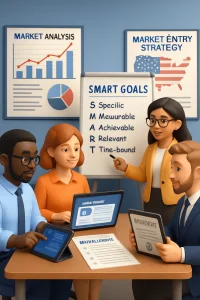
In the rapidly evolving business landscape, especially when it comes to entering new markets, it is essential for participants to have a clearly outlined set of goals for the training session on Strategic Market Entry Planning for the U.S. Business Landscape. The objective behind defining these goals is twofold: to set clear expectations for learners and to empower them with practical knowledge that can be effectively applied in real-world scenarios.
1. Creating Clear Expectations
Establishing specific goals allows participants to understand exactly what they can anticipate from the training. This clarity helps enhance the learning experience and promotes active engagement. Here are the critical expectations that participants should have:
-
Understanding of Market Dynamics: Participants will learn about the various types of market dynamics that impact new business entrants in the U.S. market, including economic indicators, consumer behaviors, and competitive landscapes.
-
Regulatory Compliance Knowledge: A comprehensive overview of regulatory requirements, including licensing and permits essential for conducting business legally in the U.S., will be provided. Participants will be equipped to navigate the complex landscape of federal, state, and local regulations.
-
Competitor Analysis Skills: Participants will gain skills in conducting competitive analysis to identify key players within the market, understanding their strategies, and determining how to position their business for success.
2. Practical Application of Knowledge
Beyond theoretical understanding, the training aims to empower participants with actionable insights. Here are specific goals related to the application of knowledge:
-
Setting SMART Goals: Participants will engage in crafting Specific, Measurable, Achievable, Relevant, and Time-bound (SMART) objectives tailored for their business expansion efforts. This exercise will ensure that they can plan effectively and measure success accurately.
-
Microlearning Engagement: Learners will experience microlearning techniques that make the training more flexible and accessible. By breaking down complex information into manageable segments, participants can easily absorb and recall information as needed.
-
Utilization of Resources: Students will be introduced to resources such as the ’Market Expansion USA Planning Guide,’ checklists, templates, and tools that can serve as ongoing references in their market entry initiatives.
3. Building a Foundation for Future Learning
The training aims not only to educate about immediate market entry strategies but also to serve as a launching pad for ongoing professional development. By the end of the session, participants will be expected to achieve the following:
-
Prepare for Real-World Implementation: Participants should leave the training with a clear action plan detailing the steps needed to implement their market entry strategy. This includes timelines, resource needs, and potential milestones.
-
Networking and Collaboration: Learners will be encouraged to engage with peers and trainers before, during, and after the training, fostering a sense of community that can be pivotal as they navigate their market entry journey.
-
Commitment to Continuous Learning: By highlighting the rapidly changing nature of the business landscape, participants should be inspired to pursue further knowledge and skills development beyond the training, including engaging in live or virtual trade missions, workshops, or other ongoing educational opportunities.
In conclusion, these clearly defined goals will guide participants throughout the training, ensuring they not only understand the critical aspects of market entry planning for the U.S. business landscape but also acquire the tools necessary to apply this knowledge effectively in their future endeavors. By aligning goals with the current learning modalities—such as microlearning and peer collaboration—this training is poised to foster a learner-centric environment that embraces the evolving nature of business education.
